Builder AI Software: Why Home Builders Need Purpose-Built AI (Not Generic Tools)
“Builder AI software” is a new search. People are typing it — home builders who have spent the last year watching AI explode across every industry and wondering: is there anything actually built for us? Not adapted from commercial construction. Not a generic project management tool with a ChatGPT button. Something purpose-built for how home builders work.
The short answer is: yes, now there is. But it's worth understanding why generic AI has fallen short for builders — because it explains exactly what to look for in builder AI software that actually delivers.
Why generic AI fails builders
Generic AI tools — ChatGPT, Copilot, the AI assistant bolted onto your existing construction software — have three fundamental problems for home builders:
It doesn't know your data
Generic AI doesn't have access to your vendor list, your floorplans, your margin targets, your design center catalog, or your buyer pipeline. Every session starts from zero. You have to explain who you are, what your communities are, and what you're trying to do before you can even ask a useful question. That's not a tool — that's a search engine with a personality.
It doesn't know your vocabulary
What's a spec level? What's a punch list in a residential construction context? What does “under contract” mean for a home builder vs a commercial contractor? Generic AI gives you generic answers — definitions from training data, not insights from your actual business. When you ask it to analyze your design center margins, it can't. When you ask it to flag homes with budget variances, it has nothing to work with.
It can't take action
Generic AI generates text. It can help you draft an email or write a job description. But it can't create a purchase order in your system. It can't update a home's construction status. It can't generate a design center summary PDF from real selection data. It can't send a bid invitation to your vendor list. Action is the whole point — and generic AI can't do it.
What purpose-built builder AI looks like
Purpose-built builder AI software has three things generic tools don't:
Persistent memory. It remembers your vendors. It knows which subcontractors you prefer for which scopes. It learns your margin targets and applies them automatically in analysis. It knows your communities and floorplans without you having to explain them. The more you use it, the more useful it gets — because it accumulates context about your specific business.
Construction vocabulary. Purpose-built builder AI understands what a spec level is, what a design center option class means, what a Scope of Work document should contain, and what questions to ask when analyzing a vendor bid. It was built around construction workflows — not adapted from generic project management.
Real data access.It reads and writes your actual records. When you ask for a budget variance analysis, it's reading your actual committed costs vs. budgeted amounts. When it generates a punch list, it's using the home's actual address, trade assignments, and room layout. When it drafts a bid invitation, it's pulling from your actual vendor database.
Foreman AI's approach
Foreman AI is the AI agent inside Cornerstone PM™. It was designed from the ground up for home builders — not adapted from a generic AI assistant. Here's what that means in practice:
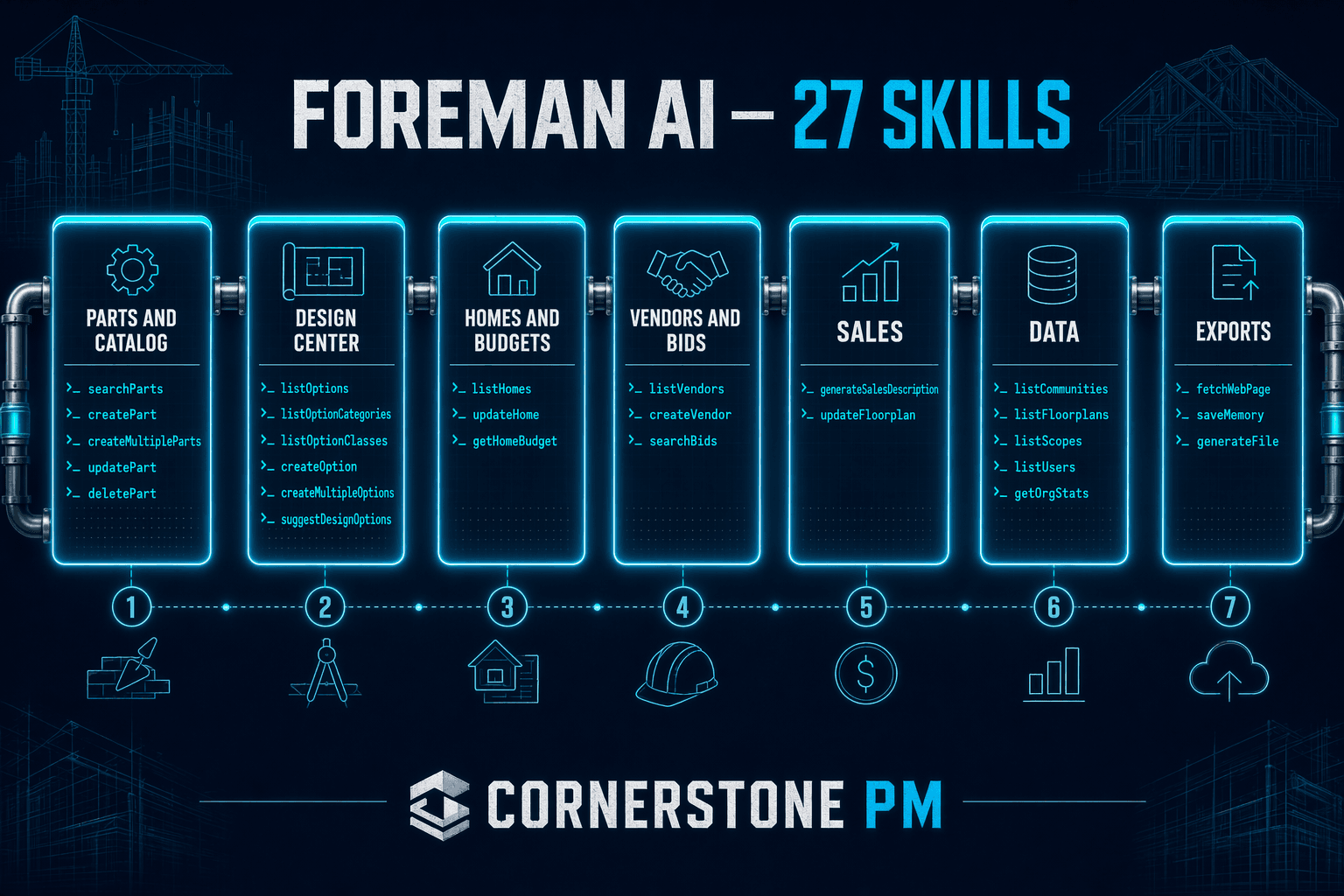
Foreman has 396+ purpose-built skills organized into 20 categories — Design Center (49 skills), Scheduling (32), Structural Options (27), Scope Items (26), Option Attributes (23), Locations & Takeoffs (22), Parts Catalog (21), and 13 more domain-specific buckets across data management, analysis, document generation, and system intelligence. Every skill was designed for a specific job that home builders actually need done.
It reads and writes real data — your parts catalog, vendor list, home statuses, buyer selections, budgets, design center options, and sales pipeline. It's not summarizing text you paste in. It's running actual queries against your actual database and returning actual results.
And it uses persistent memory to learn your business. The first time you tell Foreman your margin target for a community, it remembers. The next time you ask for a profitability report, it uses that target without you having to repeat yourself.
What builder AI software actually looks like in practice
Here are four examples of the kind of intelligence purpose-built builder AI delivers:
“Flag any homes where actual costs are more than 10% over budget”
3 homes flagged. Breakdown by scope category with variance amounts and recommended actions.
“Which of our buyers still have incomplete design center selections with a close date in the next 60 days?”
4 buyers flagged. Missing categories listed per buyer. Suggested outreach priority by close date.
“Scrape Home Depot for GE Profile refrigerators and add them to our parts catalog”
Found 6 models, added to catalog with SKUs, prices, and specs. Ready to link to design options.
“Show me vendor performance — who's winning our bids and who's behind on insurance renewals”
Scorecard generated: bid win rates, response rates, and 3 vendors with expiring certificates flagged.
None of those responses required you to paste in data. None required you to explain what a design center is. Foreman already knows — because it has access to your actual records and it understands how home builders work.
The bottom line
Builder AI software is a real thing now — but you have to know what to look for. The difference between generic AI and purpose-built builder AI is the difference between a tool that can answer questions and a tool that can run your business.
Generic AI will tell you what a budget variance is. Purpose-built builder AI will show you exactly which homes have one — and how much it's going to cost you if you don't act.
Cornerstone PM™'s beta is open now. Foreman AI is included in the Pro plan. Early adopters get two years free.
Try builder AI built for home builders
Foreman AI — 396+ skills, real data access, persistent memory. Beta is free for 2 years.
Request Beta Access