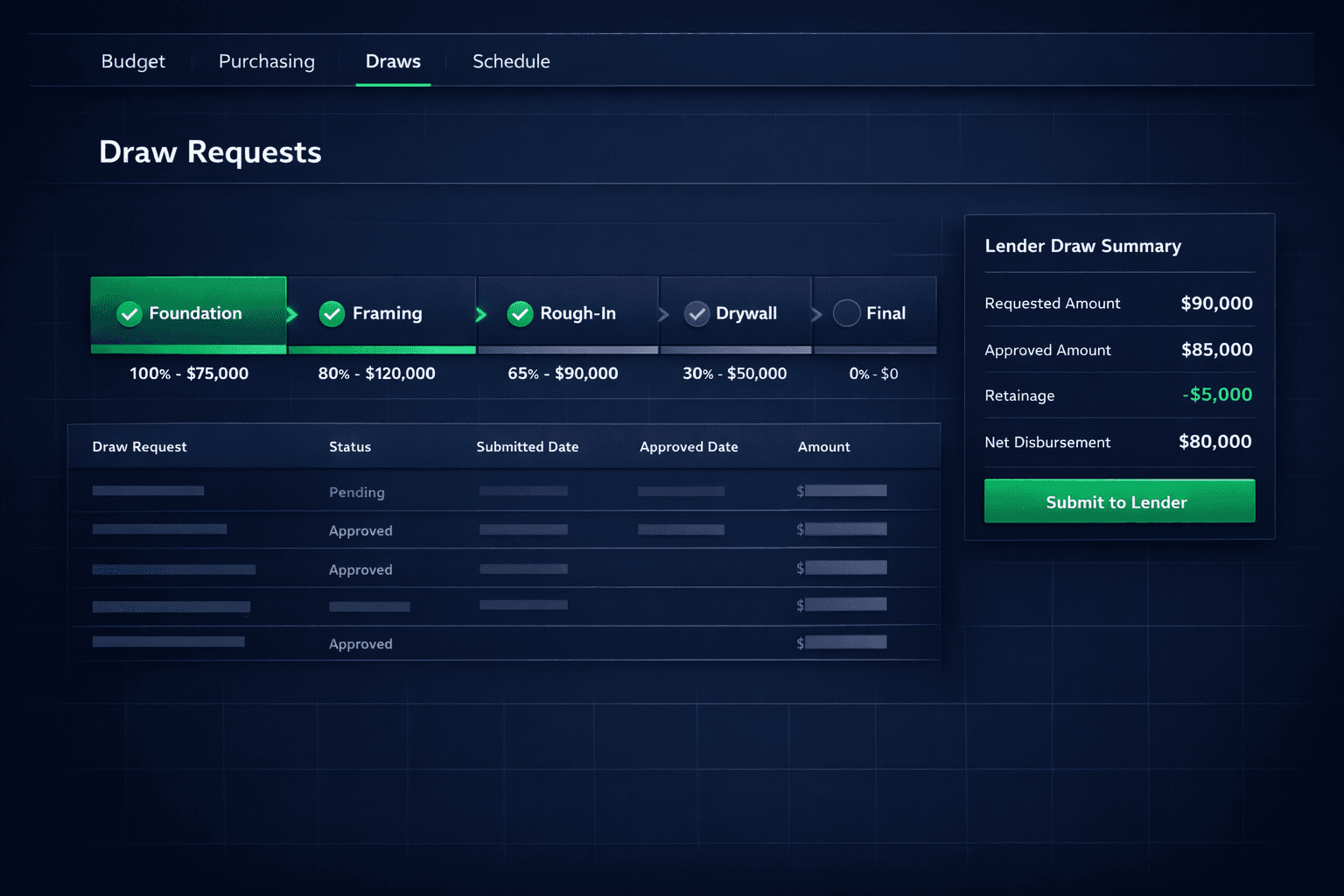
Construction Draw Requests: How Production Home Builders Get Paid Without Slowing the Schedule
A construction draw request moves faster when the completion percentage, committed cost, and invoices behind it already live in one system — not when someone has to reconstruct all three from email and spreadsheets every time a lender asks a follow-up question. That single gap is why draw packages that should take an hour end up taking a week, and it's one of the quieter costs covered in our home builder project management software guide.
Every production builder running a construction loan knows the rhythm: hit a stage, submit a draw, wait for the lender to release funds, keep paying subs and suppliers out of whatever cash is on hand until the check clears. When that rhythm breaks — when a draw gets kicked back for missing documentation or a mismatched invoice — the whole community's cash flow feels it, not just one lot.
What triggers a draw request at each stage?
Construction loans release funds in stages, not all at once, and each stage has its own documentation requirements. Here's the typical sequence for a single-family production home:
Foundation
The first draw request, tied to the foundation line items in the budget. Lenders want proof of completion before releasing funds — a photo, an inspection date, and the committed cost against that trade.
Framing / Rough-In
The largest draws typically land here, spanning framing, plumbing, electrical, and HVAC rough-in. This is also where change orders most often creep into a budget without getting flagged before the draw package goes out.
Drywall / Trim
Interior finish trades draw against allowances — flooring, cabinets, countertops. If a buyer upgraded past their allowance, that delta needs to be priced into the draw or the builder eats the difference.
Final / Certificate of Occupancy
The last draw, often held back partially as retainage until final inspection and CO. Builders who track retainage separately from the running budget avoid surprises at closing.
Why do draw packages get held up?
The delay is almost never the construction work itself — the foundation is poured, the framing is up. The delay is proving it. A lender wants to see the completion percentage, the cost committed against that stage, and supporting invoices or lien waivers, all reconciled against each other. When a builder's budget lives in one spreadsheet, purchase orders live in a separate purchasing tool, and invoices sit in an email inbox, someone has to manually assemble all three before the draw package goes out — and manually re-check them again if the lender has a question.
That reconciliation gap is also where change orders quietly inflate a draw request. If a framing extra or an allowance overage never got logged against the original budget line, the draw package either understates what was actually spent or overstates what the lender should approve — and either version invites a follow-up call that pushes the disbursement back a week.
How does live job cost data change the draw process?
When purchase orders, change orders, and invoices are tracked against the same budget lines in real time, the numbers a draw package needs are already correct at the moment the stage completes. There's no separate reconciliation step, because the committed cost, the invoiced cost, and the completion percentage were never allowed to drift apart in the first place.
That matters most on communities running multiple homes at once. A builder submitting draws for eight lots in the same month can't afford to rebuild the documentation from scratch for each one — the budget and PO data need to already reflect the true state of every lot, not just the one someone happened to check last.
How Cornerstone PM keeps draw data current
Cornerstone PM ties every purchase order and change order to a budget line the moment it's issued or approved, and matches invoices against those POs as they come in. That means the committed cost, invoiced-to-date total, and completion percentage for any lot are current at all times — not reconstructed at draw time. Builders still assemble and submit the draw package to their lender; Cornerstone makes sure the numbers behind it are never a guess.
The same AI takeoff data that generates the original budget flows straight through to purchasing and job costing, so a draw package built in month eight of a build reflects the same underlying numbers as the estimate from month one — just updated with everything that actually happened in between.
Keep draws moving on every home, not just the ones you check
A draw request shouldn't be the moment a builder finds out their budget and their invoices disagree. The builders who move draws fastest are the ones whose budget, purchasing, and job cost data never had a chance to drift apart — because it all lives in the same system from the first PO to the final inspection. That's the same principle behind everything else in our home builder project management software platform: one source of truth, updated in real time, instead of five systems reconciled by hand.
Stop rebuilding draw packages from scratch every month.
Cornerstone PM keeps budgets, purchase orders, change orders, and invoices in sync in real time — so the numbers behind every draw request are already correct.
Request Early Access