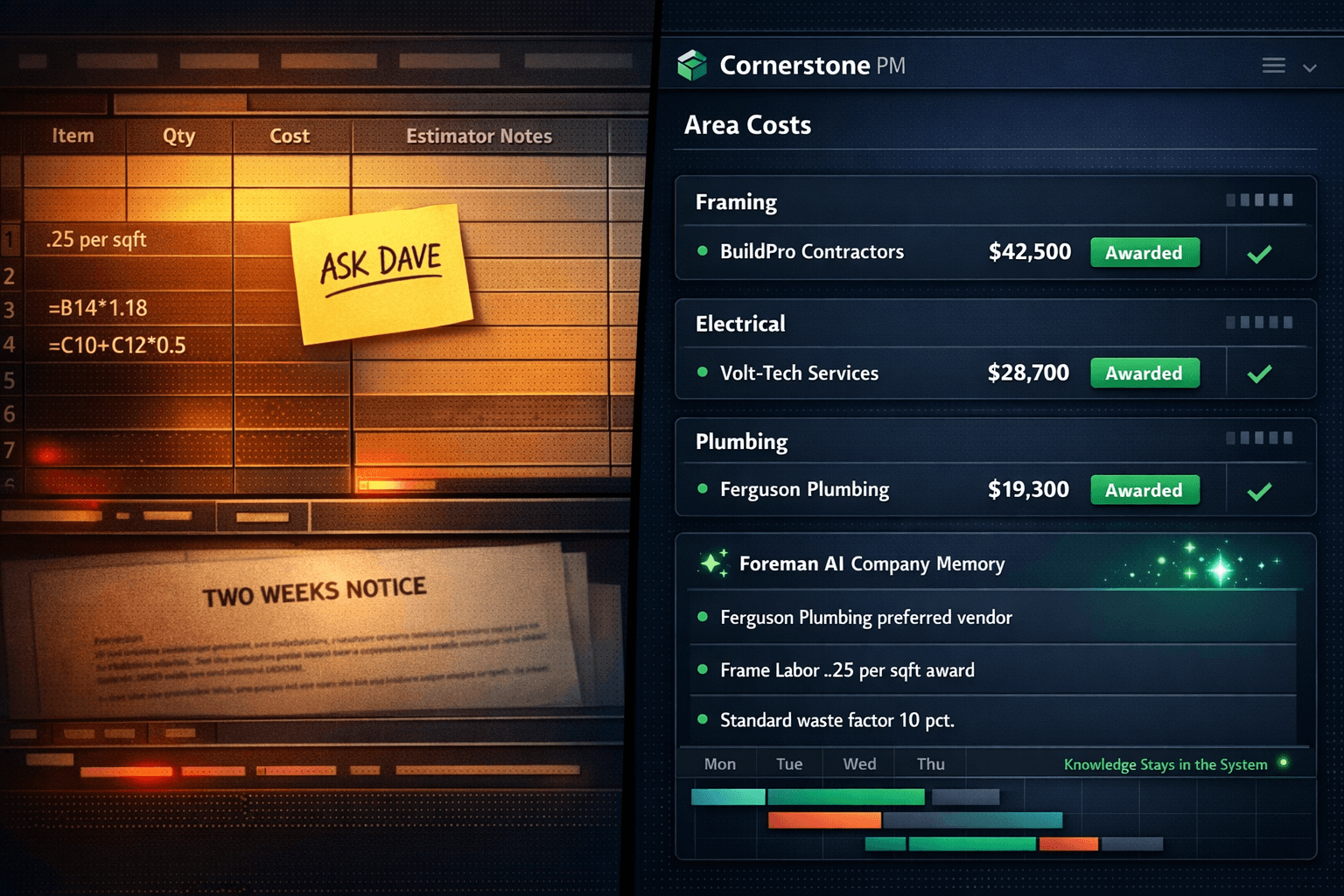
What Happens to Your Budgets When Your Estimator Quits
The spreadsheet survives. The reasoning does not. The fix is not documentation nobody maintains — it is a system where the reasoning is structural.
Every home building operation has one. The veteran who has been pricing the Hawthorne plan since before anyone else on the team was hired. They know the framing waste factor off the top of their head, which plumber to call in Riverside versus Oakmont, and why cell G47 has a hard-coded number that nobody touches. Their notice period is two weeks. The knowledge is not in the file.
When they leave, the next estimator inherits a spreadsheet that produces numbers. They do not inherit the logic behind them. They add their own guesses on top. Over time, the budget drifts away from reality in ways that are hard to trace — until a job closes and the margin is not where it should have been.
What knowledge actually walks out the door?
The problem is not the numbers themselves — those are in the file. The problem is everything the numbers depend on that was never written down.
What lives in the estimator's head vs. the system
The waste factor is not the issue. The issue is that nobody on the incoming team knows which waste factor applies to which trade and why — or whether the framing number already includes it or assumes the vendor handles it. Those assumptions compound quietly across every plan until a job closes wrong.
Why documentation does not solve it
The instinct is to document. Make the departing estimator write it down. The problem is that construction estimating knowledge is not a list of facts — it is a set of judgment calls accumulated over years of bid rounds, vendor relationships, and plan revisions. You cannot put a decade of calibration into a Google Doc in two weeks. Even when you try, the document is out of date within a quarter and nobody maintains it because nobody owns it.
The fix is not documentation. It is a system where the decisions are structural — where the reasoning is encoded in how the budget is built rather than written alongside it.
How Cornerstone encodes the reasoning
The foundation is the hard-cost rule: nothing in Cornerstone carries a stored or default cost. All cost flows from accepted vendor pricing, and a line with no awarded bid shows as $0 / needs pricing instead of a fabricated number. That eliminates the single biggest source of invisible tribal knowledge — the hardcoded cell that a veteran knows is right but a newcomer cannot verify.
When every dollar traces to an accepted bid, the next estimator does not have to guess why the framing number is what it is. They can look at the awarded bid, see who submitted it, and see when it was accepted. The reasoning is structural because the number cannot exist without its source.
The spreadsheet failure pattern
A new estimator inherits a file. They cannot tell whether the framing number includes waste or assumes it is in the vendor quote. They guess wrong. The job closes 4% under margin. Nobody connects it to the estimator transition.
The structural system pattern
A new estimator opens the community in Cornerstone. Framing shows an awarded bid from BuildPro Contractors at $42,500 — accepted June 3. The bid includes the scope description. If the bid is wrong, the next round fixes it. Nothing is hidden.
Scope-first area costs: organization that explains itself
The second structural element is how budgets are organized. In a spreadsheet, costs accumulate in whatever order someone added them — a mix of trades, unclear scope splits, and lines that only make sense to the person who entered them. A newcomer cannot read the budget; they have to have it explained.
Cornerstone budgets are scope-first. You pick or create a scope first, then add scope-filtered parts, scope items, or allowances under it. One bucket per scope, and the bucket title is the scope: Framing, Electrical, Plumbing, each containing only lines that belong to that trade. Because the pickers are scope-filtered, you cannot accidentally file a plumbing cost under electrical — the organization is enforced by the system, not by institutional memory.
A new estimator can read a Cornerstone budget without asking anyone what each section means. The structure explains itself.
Community vendor awards: making pricing decisions visible
One of the most valuable things an experienced estimator carries is vendor relationship knowledge — not just who to call, but who won which community and why. In Cornerstone, vendor awards are per community and on the record. BuildPro won Riverside; a different framer won Oakmont. The awarding decision is explicit, reviewable, and carries into the next bid round.
When the estimator who made those decisions leaves, the vendor assignment does not leave with them. The new person can see which vendor is active in each community, when the bid was accepted, and what the awarded pricing is. They can also see which vendors submitted competing bids — the whole bid history is visible, not just the winning number.
Foreman AI company-wide memory
The third layer is Foreman AI's company-wide memory. Foreman carries two memory types: per-user (your name, role, preferred vendors, communication style) and company-wide (vendor scorecards, standard patterns, builder defaults). Company-wide memory is shared across the team — it does not belong to any individual.
That means the preferred plumber, the standard waste factor, and the builder's naming conventions for scope items all persist when a team member leaves. Foreman does not need the departing estimator to explain how the operation works; it already has that context stored at the company level. The new estimator can ask Foreman AI why a scope is set up a certain way and get an answer grounded in what the company actually does, not a generic construction best practice.
What stays in the system when someone leaves
Every awarded vendor bid per community
Visible, traceable, re-biddable
Scope-first area cost structure
Files every cost under the right trade automatically
Foreman AI company-wide memory
Preferred vendors, standard patterns, builder defaults
Estimating formulas in shared knowledge base
Auto-quantities off floorplan square footage
Full bid history per scope
Who submitted, who won, when it was awarded
An honest caveat
No software replaces a good estimator. The vendor relationships, the scope intuition, the ability to spot a bid that looks right but is missing something — that is still a human job. What a structural system does is make sure the next person starts from the record of what the previous person decided rather than an undocumented spreadsheet they have to reverse-engineer under pressure.
The departing estimator built something valuable. A good system captures it. A spreadsheet loses it.
Build a budget system that outlasts any one person.
Cornerstone PM ties every dollar to an accepted vendor bid, files every cost under its trade, and stores vendor knowledge at the company level — so your pricing logic stays in the platform, not in someone's head.
Request Early Access