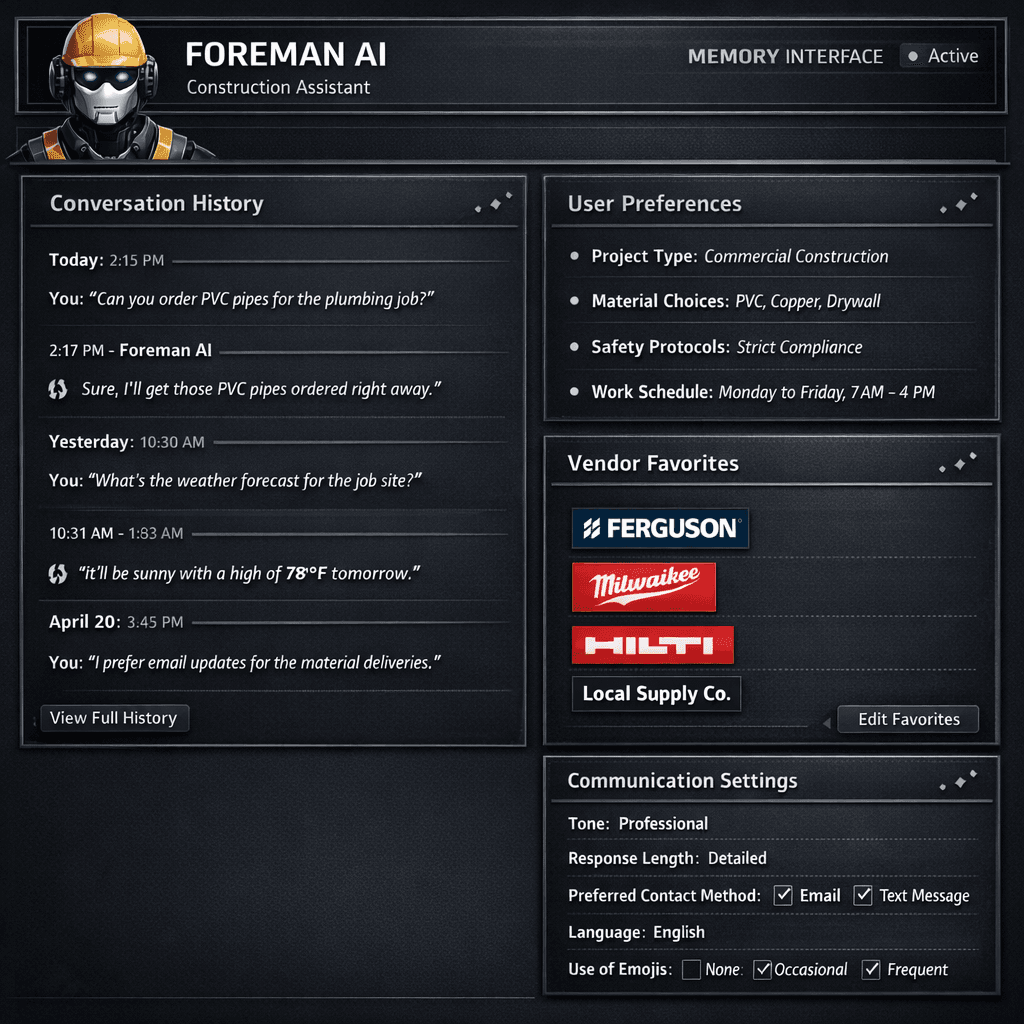
Foreman AI Memory: The First Construction AI That Doesn’t Forget
Foreman AI remembers who you are, which vendors you prefer, and how you like to work — and it carries that knowledge into every conversation, every time. It’s the only construction AI built with persistent per-user and company-wide memory.
Every other AI tool you’ve tried — whether it’s a generic chatbot bolted onto construction software or a general-purpose assistant you’ve tried to adapt — starts each session with a blank slate. You re-explain your role. You remind it which vendor you prefer for plumbing. You specify again that you want short answers. Foreman AI’s memory architecture eliminates all of that. To see the full picture of what Foreman can do, visit the Foreman AI overview.
Why does AI memory matter for home builders?
Construction is a relationship business. The superintendent who’s been working with Ferguson for fifteen years doesn’t want to specify “prefer Ferguson for plumbing” in every prompt. The sales agent who quotes in finished square footage doesn’t want to re-explain their vocabulary every morning. The owner who hates lengthy reports doesn’t want to ask for brevity each time.
Generic AI tools have no way to hold that context. They treat each conversation as a completely isolated event. The result: every session feels like meeting the AI for the first time. That friction isn’t just annoying — it’s the reason most builders try an AI tool twice and give up. The cognitive overhead of re-establishing context cancels out the time savings.
Foreman AI was designed to solve this at the architecture level, not as an afterthought feature.
Two memory layers: personal and company-wide
Foreman AI operates with two distinct persistent memory layers working simultaneously:
Per-User Memory
- ›Your name, role, and team
- ›Preferred vendors per trade
- ›Communication style preferences (brief vs. detailed)
- ›Vocabulary and units you work in
- ›Saved workflow shortcuts and recurring tasks
Company-Wide Memory
- ›Vendor scorecards built over time
- ›Community-level vendor assignments and history
- ›Recurring scope patterns and material preferences
- ›Builder-level defaults across plans and communities
- ›Historical bid data and pricing trends
The combination means Foreman answers questions with the full context of your role AND your company. When a superintendent asks Foreman to draft a plumbing purchase order, it already knows which vendor they prefer, which community is active, and what the awarded pricing was the last time this scope ran. No setup prompt required.
Three scenarios where memory changes everything
The superintendent who always orders from Ferguson
Without memory: every time Mike opens Foreman and asks for a plumbing PO, he types “use Ferguson as the vendor.” With memory: Foreman already knows Mike prefers Ferguson for all plumbing scopes. The PO drafts with Ferguson pre-selected. If Ferguson’s bid wasn’t the awarded price, Foreman flags it rather than silently overriding the awarded vendor.
The sales agent who quotes in finished square footage
Sarah works in finished square footage, not total square footage. Without memory: she corrects Foreman’s outputs to the right unit every session. With memory: Foreman learned during their first conversation that Sarah’s vocabulary is “under air sqft.” Every report, every quote, every comparison comes back in her units. No correction needed.
The owner who hates lengthy responses
The builder-owner wants direct answers: numbers, action items, nothing else. Without memory: Foreman defaults to detailed explanations and the owner trims the response manually every time. With memory: Foreman learned on day one that this user wants one-line answers with a clear action. The next 200 conversations stay concise automatically.
What is the context health meter?
Long working sessions are normal in construction — a 90-minute design center cleanup, a full catalog repricing run, a multi-step purchasing workflow that spans dozens of scope items. Generic AI tools quietly fail during long sessions: they hit their context limit, forget the first half of the conversation, and start giving answers that contradict what you established earlier.
Foreman AI ships a built-in context health meter — a green/yellow/red indicator visible in the UI that tells you how much working memory the current session has consumed. When the meter turns yellow or red, Foreman’s automatic memory compaction kicks in: it intelligently summarizes older parts of the conversation, compresses them into a compact representation, and continues the session without losing any critical context.
The result: Foreman can run through marathon sessions — 200+ option cleanups, full catalog imports, multi-step workflows spanning hours — without hitting a wall or forgetting what happened at the start. No other construction AI does this.
For a deeper look at the technical architecture behind Foreman’s agentic loop and long-session handling, read how Foreman chains 75 actions in a single prompt.
How Foreman memory compares to ChatGPT and competitor AI tools
ChatGPT has a memory feature. It stores a few bullet points about you globally and surfaces them at the start of new conversations. It’s better than nothing, but it doesn’t know what framing labor costs in your market, which vendor won your last concrete bid, or how your design center is organized. It’s a generic notebook, not a construction brain.
Foreman AI’s memory is backed by a 24,500-word construction knowledge base, 396+ purpose-built skills for home building workflows, and direct database access to your actual Cornerstone PM data. When Foreman remembers that you prefer Ferguson, it can pull Ferguson’s current bids from your database and draft a real purchase order against real awarded pricing. That’s not note-taking — that’s an agent that knows your business.
| Capability | ChatGPT Memory | Competitor Construction AI | Foreman AI |
|---|---|---|---|
| Remembers user preferences across sessions | ✓ | ✗ | ✓ |
| Company-wide vendor & scope memory | ✗ | ✗ | ✓ |
| Construction-specific knowledge base | ✗ | Partial | ✓ (24,500 words) |
| Direct access to your live data | ✗ | Partial | ✓ |
| Takes real actions (POs, bids, schedules) | ✗ | ✗ | ✓ |
| Context health meter + compaction | ✗ | ✗ | ✓ |
| 396+ construction skills | ✗ | ✗ | ✓ |
What else can Foreman AI do?
Memory is the foundation, but it’s one layer of a much deeper system. Foreman AI ships with 396+ skills covering the full spectrum of home builder operations:
- Purchasing: Draft POs, compare bids side-by-side, flag pricing anomalies, and send vendor messages directly
- Design Center: Rebuild option categories, update Designer Package contents, apply bulk pricing changes across floorplans
- Scheduling: Analyze schedule gaps, identify cascade risks, and generate subcontractor coordination summaries
- Reporting: Generate profitability reports, vendor scorecards, and budget variance summaries on demand
- Image analysis: Paste or drag in product photos, floor plan screenshots, or jobsite images and Foreman analyzes them in context
Foreman reads AND writes data — it doesn’t just answer questions, it takes real actions in your platform. Combined with memory that knows your preferences and your business, it operates more like a knowledgeable colleague than a search engine. Explore everything Foreman can do at the Foreman AI page.
Which plan includes Foreman AI?
Foreman AI is included on the Pro+ plan at $599/month, which also includes the REST API and BYOA (Bring Your Own Agent) access — every Foreman skill is exposed as an API endpoint, so your external automation tools get the same memory-aware intelligence. There are no add-ons or per-seat charges for Foreman features.
For builders running 20–200 homes per year, the math is straightforward: if Foreman saves one hour of purchasing work per day across a three-person team, the tool pays for itself before the end of the first week.
If you’re evaluating construction AI tools and want to understand the full production home builder platform, see how AI fits into Cornerstone PM’s full construction management stack.
Meet the AI that actually knows your business
Foreman AI remembers your vendors, your preferences, and your workflow — and it has 396+ skills to put that knowledge to work. The first construction AI that doesn’t start from scratch every time.
Request Early Access →