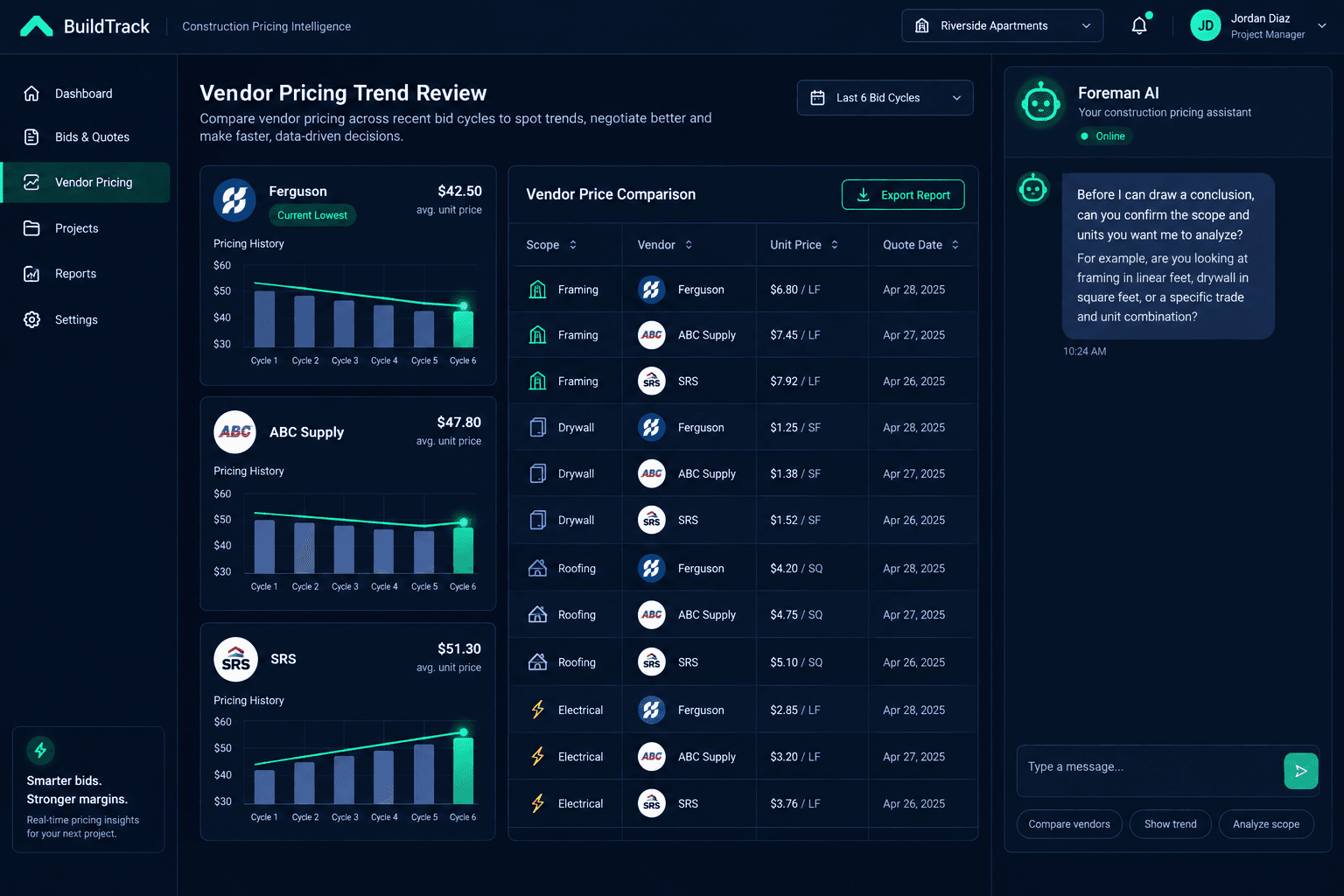
Ask Foreman About Vendor Pricing Trends Before Your Next Bid Review
Ask Foreman AI to pull vendor pricing trends from your own bid history before a purchasing review, then check scope, units, and floorplan context on each quote before treating a price difference as a decision. Foreman prepares the briefing — the review is still a human step.
Most purchasing managers walk into a bid review with a spreadsheet open in one tab and a vendor’s quote open in another, manually scanning for how this round’s numbers compare to the last one. It’s slow, and it’s easy to miss context — a quote that looks high at a glance might just cover more scope than the one you’re comparing it to. Foreman AI can shortcut the spreadsheet part: ask it to pull pricing trends across vendors from your own bid history, and it returns a summary you can use to prepare for the review — not a finished verdict you act on without checking.
What does a Foreman pricing-trend briefing actually do?
It reads your own vendor bid history inside Cornerstone PM and summarizes how pricing on a given trade has moved across recent bid cycles. Ask something like “how has framing pricing trended across our last four bid rounds” and Foreman pulls the quotes on record and lays out the pattern. That’s the whole job: preparing a briefing from data you already have, so you’re not starting the review from a blank spreadsheet.
What a pricing trend doesn’t tell you on its own
A trend line is not the same as a purchasing decision. Before treating any price difference as meaningful, check three things on each quote behind it:
Are the scopes actually equivalent?
A framing bid that includes material delivery and a framing bid that doesn't are not the same quote, even if both are labeled “framing.” Compare scope boundaries before comparing totals.
Are the units the same?
A per-square-foot number and a per-linear-foot number on the same trade don't compare directly. Confirm the unit on each quote before reading a dollar difference as real.
What floorplan and quote date is this?
Pricing on a 1,800 sqft plan from eight months ago says less than pricing on the same plan from this bid cycle. Check both before drawing a conclusion.
Foreman can help with this step too — ask it to pull the scope, unit, and floorplan on a specific quote before you compare it to another one. The point is that comparing equivalent scopes is a question you ask on purpose, not an assumption the trend line makes for you.
What questions should actually shape the review?
Rather than asking “which vendor is cheapest,” a pricing-trend briefing works better as the start of a short set of scoped questions: Has this vendor’s pricing on this specific trade moved up or down since the last award? Is the change consistent with material cost shifts the whole market saw, or specific to this vendor? Does the current quote cover the same scope as the quote it’s being compared to? Answering those with Foreman’s summary in hand turns the review into a focused conversation instead of a blind re-read of every line item.
Can Foreman pull in market data or forecast prices?
No, and it’s worth being direct about that. Foreman works from your own bid history inside Cornerstone PM — it doesn’t connect to external market feeds, industry price indexes, or competitor pricing, and it doesn’t forecast where a vendor’s pricing is headed. If a question requires evidence outside your own records, that stays an open question Foreman will say it can’t answer, rather than guess at a number.
Does Foreman negotiate or award the bid?
No. Foreman prepares the briefing; it doesn’t contact vendors, negotiate pricing, or choose a winning bid. Community vendor assignments and accepted vendor pricing remain the basis of actual home costs in Cornerstone PM, and those stay decisions a purchasing manager makes after reviewing the full picture — not an output Foreman generates on its own.
How this fits the rest of the bid review
A pricing-trend briefing is preparation, not the review itself. It sits alongside the side-by-side bid comparisons and vendor records already in Purchasing: Foreman surfaces the trend and the open questions worth asking, the purchasing manager checks scope and units on the quotes in front of them, and the award decision happens the same way it always has — based on verified, accepted vendor pricing for the actual scope and community in question.
Used this way, Foreman saves the time spent manually re-reading old bid history before a review — without removing the judgment call that has to happen once the briefing is in hand.
Frequently asked questions
Frequently Asked Questions
What is AI vendor pricing analysis for home builders?
Does Foreman pull pricing data from outside vendors or the broader market?
Can Foreman forecast future vendor prices?
Will Foreman automatically negotiate with vendors or award a bid?
What questions should I ask before trusting a price comparison?
Does a price difference between two vendors mean one is overpriced?
How does this connect to community vendor assignments?
Walk into your next bid review prepared
Foreman AI pulls vendor pricing trends from your own bid history so you spend the review asking the right questions, not re-reading old quotes.
Request Early Access