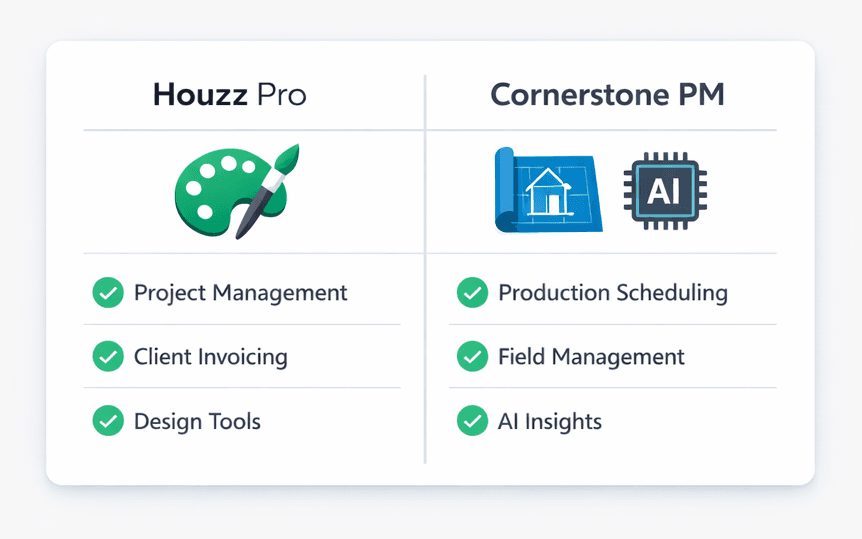
Houzz Pro vs. Cornerstone PM: Why Production Builders Outgrow a Designer-First Tool
Houzz Pro is a strong tool for interior designers and remodelers — but it was never built for a production home builder selling the same plan 40 times a year across multiple communities. If you're running floorplans, options, and vendor bids at scale, you need purpose-built home builder software, not a platform designed for HGTV-style renovation jobs.
Builders sometimes encounter Houzz Pro in “best construction software” roundups, and it can look appealing on the surface: project management, client communication, 3D visualization, and an enormous consumer network. But when you start mapping Houzz Pro's feature set against the actual workflow of a production builder, the gaps become impossible to ignore. This post is a direct, honest look at where each tool fits — and where Houzz Pro ends.
What is Houzz Pro actually built for?
Houzz Pro's core customers are interior designers, kitchen and bath remodelers, and specialty contractors who sell high-end renovation work directly to homeowners. Its power is in three areas: consumer lead generation through the Houzz marketplace (65M+ monthly visitors), client communication tools (3D room visualizers, mood boards, idea-sharing), and project financials for managing a one-off remodel budget. For a boutique remodeler doing $1M–$5M/year in custom work, Houzz Pro is a reasonable all-in-one that handles both marketing and project delivery.
That customer profile is completely different from a production builder doing 50–200 homes a year. A production builder doesn't need a consumer marketplace — their homes sell through their own sales pipeline, communities, and model homes. They don't manage one-off custom projects; they manage plan repeats. And the operational complexity of running floorplans, structural options, a buyer-facing design center, vendor bid rounds, and a Master Cost Budget across multiple communities has nothing to do with what Houzz Pro is designed to solve.
The six gaps that matter for production builders
| Category | Houzz Pro | Cornerstone PM |
|---|---|---|
| Business model fit | Interior designers, remodelers, specialty contractors | Production and semi-custom home builders (5–200+ homes/year) |
| Floorplan & plan-repeat model | No floorplan abstraction — everything is a one-off project | Floorplans defined once, options priced once, reused across every community |
| Design center | Client mood boards and idea books; no structured option pricing engine | 64 Designer Packages across 7 categories with auto-lock and exclusion groups |
| AI capabilities | None built in beyond generic content suggestions | 5 native AI agents: Foreman AI (396+ skills), Blueprint AI takeoff, Bid Import AI, MLS Generator, Support Agent |
| Consumer lead generation | Strong — 65M+ monthly visitors, consumer-facing directory and reviews | Not applicable — B2B builder platform, not a consumer marketplace |
| Purchasing & vendor bids | Basic project financials; no bid comparison, no scope-filtered Excel templates | Full bid-request workflow with no-login vendor portal, side-by-side bid comparison |
No floorplan model means every home is built from scratch
The single most important structural difference between Houzz Pro and a production builder platform is the absence of a floorplan model. Houzz Pro treats every project as a unique job — because for a remodeler, it is. But a production builder who's selling the “Magnolia” plan in three communities doesn't want to re-create that job from scratch 90 times. They want to define the Magnolia once — base price, structural options, all 64 Designer Package options, scope items tied to square footage — and have that plan repeat automatically.
Cornerstone PM's Design Center is built around exactly this model. Options are priced once at the floorplan level. A buyer upgrades the cabinet hardware on a Magnolia in Community A, and the pricing, scope, and Master Cost Budget update automatically. That same option pricing flows to every other Magnolia in every other community. Houzz Pro can't do this — not because it's bad software, but because it was never designed for plan repeatability.
Designer Packages vs. mood boards: a fundamentally different design conversation
Houzz Pro's design tools are genuinely impressive for what they do: clients can browse Houzz's library of 21M+ photos, save ideas, and build mood boards that the designer uses as a briefing tool. That's the right workflow for a $200k kitchen remodel where every decision is bespoke and the designer is curating from scratch.
Production builders need a structured selections engine, not a mood board. Cornerstone PM's Designer Packages give buyers curated, pre-priced design bundles — 64 packages across 7 categories like flooring, cabinetry, countertops, and fixtures. A buyer picks “Modern Farmhouse” and every category auto-locks to that coordinated package. Exclusion groups enforce “pick exactly one flooring type” logic so selections complete cleanly instead of leaving open-ended buyer choices. Every package price traces to real vendor costs from actual bid rounds — no filler defaults. That's a production design center. Houzz Pro doesn't have an equivalent.
AI capabilities: 396 construction skills vs. none
Houzz Pro has no meaningful AI integration for the operational side of construction. Cornerstone PM ships five native AI agents. The flagship is Foreman AI: an in-app construction agent with 396+ skills across 20 categories that reads and writes your actual data — not a chatbot that returns suggestions you have to act on manually. Foreman has per-user memory (it remembers your role, your preferred vendors, your communication style) and company-wide memory (vendor scorecards, recurring scope patterns). It reads jobsite photos with AI vision, searches and hosts product images permanently, and can create options, purchase orders, and tasks directly from a conversation.
Blueprint AI handles material takeoff: it extracts 130+ scopes from a floor plan PDF in under 60 seconds and maps them to your vendor catalog. Bid Import AI matches vendor bid documents to the right scopes and replaces instead of duplicating on re-import. These aren't add-on modules — they're bundled in the Pro+ plan alongside the REST API and BYOA (Build Your Own Agent) access.
Where Houzz Pro does win: consumer marketing reach
This is a genuine Houzz advantage and it's worth being honest about. Houzz Pro's consumer-facing marketplace brings 65M+ monthly visitors to its platform, and a well-maintained Houzz Pro profile can generate inbound leads for designers and remodelers who depend on homeowner discovery. If your business model includes selling directly to consumers who are browsing renovation inspiration, Houzz Pro's marketing reach is real and hard to replicate.
Production builders don't sell through Houzz's consumer marketplace. They sell through their own communities, model home centers, and sales pipelines. The lead generation value that makes Houzz Pro compelling for a remodeler is simply not relevant to the production builder segment.
The honest verdict: right product, wrong segment
Houzz Pro is not a bad product — it's the wrong product for production home builders. If you're running a design-build remodeling firm, renovating high-end kitchens, or selling your interior design services to homeowners who find you through Houzz's marketplace, Houzz Pro is legitimately useful. If you're building 50–200 homes a year across multiple communities with plan repeats, options pricing, vendor bid rounds, and a buyer-facing design center, Houzz Pro is missing every operational layer you depend on.
The production builder software category is purpose-built for this complexity. For a full breakdown of what to look for when evaluating platforms, see our home builder project management software guide — it covers the decision criteria that matter most for builders running plan repeats at scale.
Built for production builders, not remodelers
Floorplan-driven budgets, 64 Designer Packages, Blueprint AI takeoff, and 396+ Foreman skills — all in a platform designed from the ground up for builders selling plan repeats across multiple communities.
Request Early Access