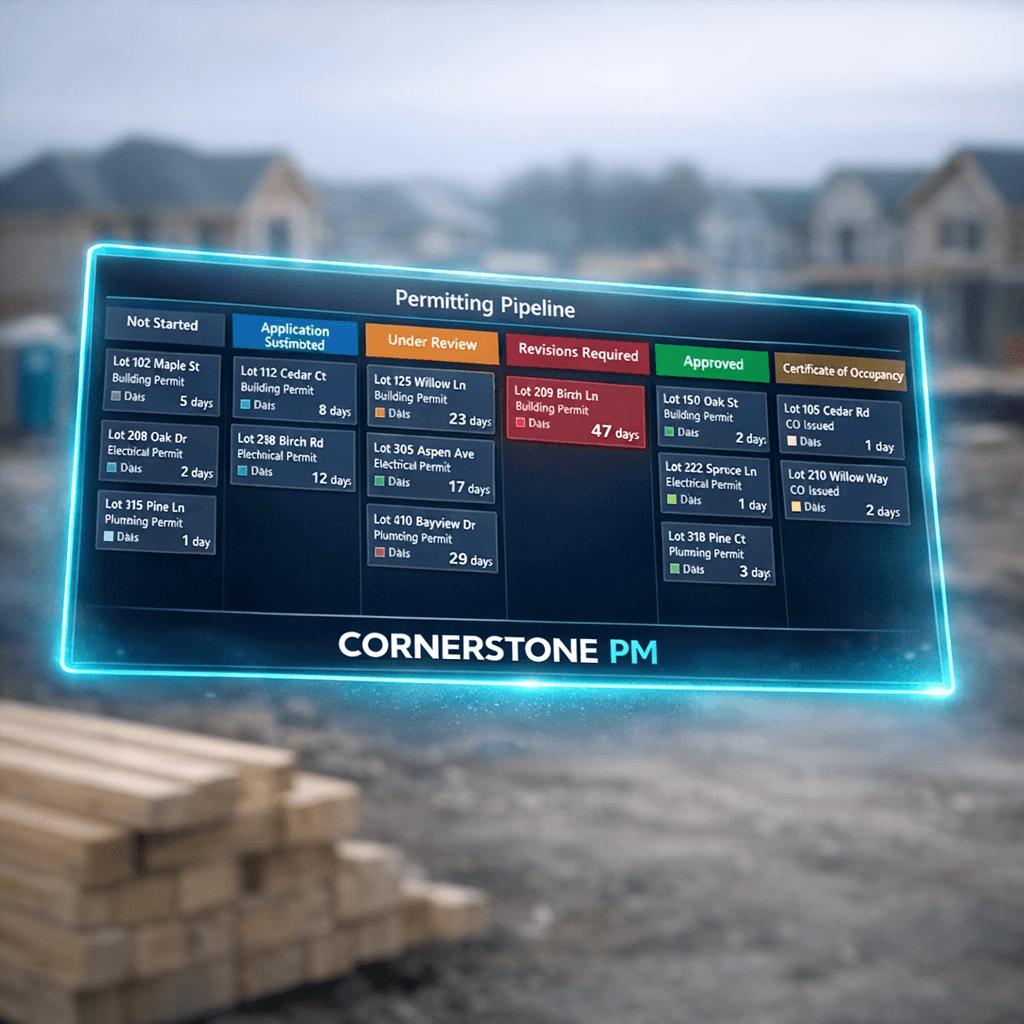
Why Permits Are Stalling Your Build Schedule
You've got subs lined up, lumber on order, and a buyer checking their portal every morning. Then the municipality sits on your framing permit for three weeks — and your entire schedule collapses like a house of cards.
Permitting delays are the most predictable unpredictable problem in residential construction. Every builder knows they're coming. Few have a system that actually accounts for them. The result? Idle crews, frustrated buyers, and margin lost one delayed day at a time.
The real cost of a permit bottleneck
Most builders track permits the same way they track everything else: a sticky note, a spreadsheet column, or the nagging feeling in the back of their head. That's not a system — that's wishful thinking.
Here's what a single untracked permit delay actually costs:
Subcontractor rescheduling fees
When your framing permit is late and your framing crew shows up anyway, someone eats the cost of a wasted mobilization. Do that twice per community and you've burned thousands of dollars in avoidable rescheduling.
Buyer trust erosion
Your buyer had a close date circled on the calendar. Now it's moving. You can explain permitting delays all you want — what they hear is "we didn't have a plan." Buyers who feel blindsided don't refer their friends.
Compounding schedule drift
A two-week permit delay doesn't just cost two weeks. It shifts your HVAC rough-in, your insulation crew, your drywall sub — everyone downstream. A single bottleneck can add a month to your close date if you don't catch it early.
Revenue timing impact
Delayed closes mean delayed draws. On a 20-home community, even a one-week average slip per home can materially affect your quarterly cash flow. Permitting isn't just a scheduling problem — it's a financial one.
What builders with tight schedules do differently
The builders who consistently hit their close dates aren't lucky — they treat permitting like a managed workflow, not a waiting game. A few habits that separate them from the rest:
They apply early and track status actively. Instead of submitting a permit application and hoping, top builders submit well ahead of planned start dates and follow up at consistent intervals. They know which municipalities run two weeks and which run six — and they plan accordingly.
They tie permit status directly to the schedule. If a permit isn't approved, no downstream work should be scheduled as confirmed. That sounds obvious, but most scheduling tools don't enforce it — your framing crew gets booked whether the permit is in hand or not.
They communicate proactively with buyers.When a permit is running late, great builders don't wait for the buyer to notice a missed milestone. They get ahead of it — a quick update explaining the delay and the new expected timeline goes a long way toward maintaining trust.
How software changes the equation
The biggest problem with spreadsheet permit tracking isn't that it's hard — it's that it's disconnected. Your permit status lives in one place, your build schedule lives in another, and your buyer communication lives in a third. Nothing talks to anything else.
Purpose-built builder software connects these dots. When a permit status changes — submitted, under review, approved, or flagged — that update flows into the schedule. Crew start dates shift automatically. The buyer's homeowner portal reflects the updated timeline. Your superintendent gets an alert. No manual data entry, no version confusion, no forgotten follow-ups.
Cornerstone PM™ includes a permitting tracker built into the same platform as your construction schedule, sales pipeline, and buyer portal. When a permit clears, the system knows — and your schedule responds. No more chasing city hall with one hand and texting your sub with the other.
The bottom line
You can't make the city move faster. But you can build a system that makes permit delays less damaging — by catching them early, connecting them to your schedule, and communicating them clearly to your buyers. That's the difference between a delay that costs you two weeks and one that costs you two months.
Stop treating permitting as something that happens to you. Start managing it like the critical path item it actually is.
See how Cornerstone PM™ tracks permits alongside your build schedule
Join the beta — free for 2 years for early adopters.
Get Beta Access