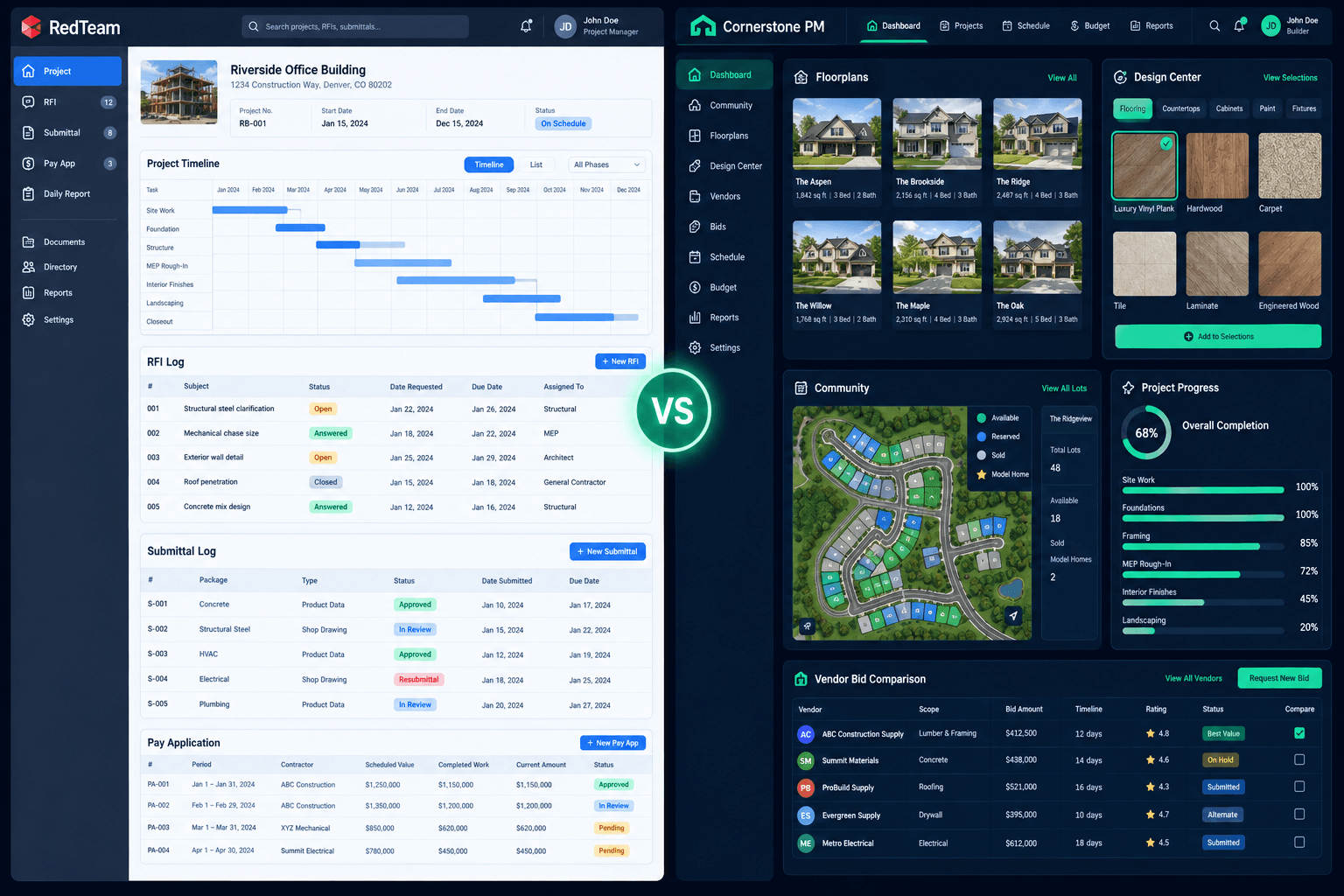
RedTeam vs Cornerstone PM: Commercial Project Workflows or Repeatable Homebuilding?
RedTeam is construction software built for commercial general contractors: preconstruction bids, RFIs, daily reports, and job-cost financials on a single project billed to an owner. Cornerstone PM™ is built for production home builders selling the same floorplan dozens of times across several communities. Both are real construction software. The question is whether a project-by-project commercial tool fits a business built around repeatable homes.
This isn't a teardown of RedTeam — it's a well-regarded platform for the commercial GCs it targets. The question worth answering before a production builder evaluates it is simpler: does a single-project data model hold up once the same plan is being sold 80 times a year across five communities?
What is RedTeam built for?
RedTeam positions itself around small-to-mid-sized commercial general contractors who want a single platform instead of a stack of point tools, organized around three phases of a commercial project:
- Preconstruction— bid management, estimates, and subcontractor communication before a project breaks ground.
- Project management — daily reports, RFIs, submittals, document sharing, and field updates once construction is underway.
- Financials & closeout — real-time job costing, invoicing, pay applications, and work-in-progress visibility through to project closeout, with QuickBooks and Xero sync.
For a commercial GC billing an owner on percentage-complete across a school, office, or retail build-out, that phase structure maps directly onto how the work actually happens. The unit of work is the project, from first bid to final pay application.
Why a production home builder's unit of work is different
A production builder selling 20–150 homes a year isn't running 150 unrelated projects. The same floorplan — say, the Magnolia — gets built dozens of times across several communities, with the same base structure and a defined set of buyer options every single time. The operational question isn't “how do we manage this one project,” it's “how do we price and build this plan the same way, correctly, every time it sells.”
That shift changes what the software needs to model:
- Plan-level pricing: Options and structural variants are priced once against the floorplan and reused every time that plan sells — not rebuilt per project the way a one-off commercial bid would be.
- A buyer-facing design center: Home buyers pick finishes and upgrades directly, and those selections flow into purchasing automatically. RedTeam has no equivalent — its submittals and RFIs are built for architect/owner/GC coordination, not a homeowner choosing flooring.
- Community-assigned vendor pricing: The framing crew in Community A may differ from Community B, and awarded pricing locks per community so it doesn't drift mid-cycle across dozens of homes.
- Multi-community, multi-lot structure: Builders need lots, models, and communities as first-class objects, not a flat list of standalone jobs.
None of this means RedTeam is missing features — its preconstruction, RFI, and pay-application tools are built for a different unit of work entirely. For the full picture of what plan-level production tooling looks like, see the Cornerstone PM™ design center.
Feature comparison: RedTeam vs Cornerstone PM™
| Feature | RedTeam | Cornerstone PM™ |
|---|---|---|
| Floorplan / model home concept | ||
| Per-floorplan options reused across plan repeats | ||
| Buyer-facing design center | ||
| Designer Packages / exclusion groups | ||
| Multi-community lot & vendor management | ||
| Community-assigned, locked vendor pricing | ||
| AI material takeoff from floor plan PDF | ||
| Foreman AI (construction-specific assistant) | ||
| Preconstruction bid management | Partial | |
| RFIs & submittals | ||
| Daily field reports | Partial | |
| Job-cost financials & pay apps | Partial | |
| QuickBooks / Xero accounting sync | Partial |
“Partial” reflects workflows Cornerstone PM™ supports in a residential-specific form rather than a direct commercial-GC equivalent — for example, job costing happens through the purchasing module's Master Cost Budget rather than a standalone pay-application workflow.
How does vendor bidding compare?
RedTeam's preconstruction bidding is built to solicit and compare subcontractor bids against a single project's scope. Cornerstone PM™runs the same underlying idea — scope-filtered bid requests, a no-login vendor portal, side-by-side comparison — but scopes it to a floorplan and a community instead of a standalone job. An awarded concrete price doesn't just cover one house; it's the price that applies to every home of that plan built in that community until it's renegotiated, and it locks after acceptance so it can't shift mid-cycle.
Who should use each platform?
Use RedTeam if you are…
- A commercial general contractor billing owners on percentage-complete
- Running RFIs, submittals, and daily reports on owner/architect-coordinated projects
- Managing preconstruction bidding and pay applications project by project
Use Cornerstone PM™if you are…
- A production home builder selling the same floorplans across multiple communities
- Running a buyer-facing design center with options priced once at the plan level
- Awarding vendor pricing per community and locking it once accepted
RedTeam is a credible choice for the commercial GC it's built for. If you're a production home builder who ran across it while comparing “construction project management software,” the mismatch isn't a feature gap — it's that a commercial, project-by-project data model doesn't carry a repeatable floorplan, options, and community structure. Start with the full home builder software category overview to see how platforms built specifically for production homebuilding compare.
Built for repeatable homes, not one-off commercial projects
See how Cornerstone PM™prices a floorplan once, runs a buyer-facing design center, and locks vendor pricing per community — the workflows a commercial project management tool was never built for.
Request Early Access