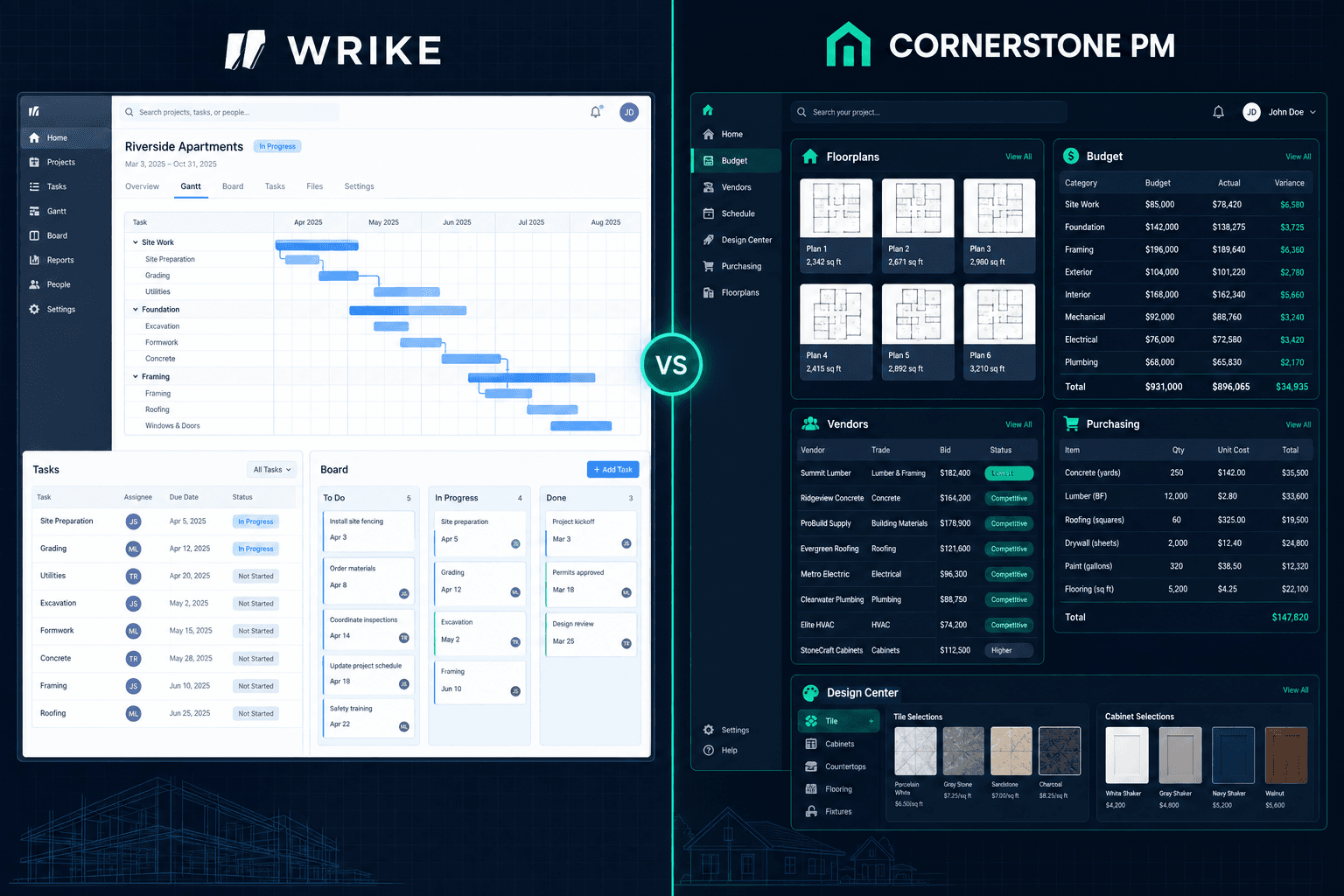
Wrike vs Cornerstone PM: Configurable Work Management or a Homebuilding Workflow?
Wrike is a configurable work management platform that construction teams can adapt with custom fields, Gantt charts, and integrations. Cornerstone PM™ is a homebuilding workflow that ships with the production builder data model already connected — floorplans, options, vendor bids, and budgets in one place. Which one fits depends on whether you want to configure a general tool or run a workflow built for the job.
Wrike markets directly to construction on its construction industry page, and the positioning is genuine: real-time dashboards, Gantt-based scheduling, budget tracking with custom fields, document approvals for drawings and change orders, and a marketplace of 400+ integrations. For a general contractor or multi-department organization that wants one configurable platform across teams, that's a reasonable pitch. For a production home builder repeating the same floorplans across multiple communities, the question is different: how much of your actual workflow do you have to build yourself before the tool works the way your business does? For the full category overview, start at home builder project management software.
What does Wrike actually offer construction teams?
Wrike's construction page leads with a few concrete capabilities worth taking at face value:
- Interactive Gantt charts — drag-and-drop task dependencies and shared project calendars across teams.
- Budget tracking via custom fields — real-time reports built from fields the team configures per project.
- Document approvals — online proofing and sign-off workflows for site plans, drawings, and change orders.
- Resource and time management — team availability views, workload reallocation, and contractor time tracking.
- 400+ integrations — Slack, Microsoft, Google, Adobe, Salesforce, and other general-purpose tools connect natively.
None of that is a criticism. Wrike is a capable, well-established work management platform, and its construction messaging is credible for coordination-heavy general contracting work: RFIs, submittals, approvals, and cross-team visibility on a project-by-project basis.
What has to be built vs what ships connected
The honest way to evaluate Wrike for production homebuilding isn't to say it lacks scheduling or automation — it has both. The real question is how much configuration stands between a blank workspace and the specific workflows a production builder runs every day:
- Floorplan-level pricing: A production builder sells the same floorplan dozens of times across several communities, and options need to price once at the plan level and apply everywhere that plan is sold. Wrike has no floorplan object — a builder would need to represent each plan as a custom project template and manually keep option pricing in sync across every instance.
- Buyer-facing design center:Cornerstone PM's design center gives buyers a selections portal with 64 curated Designer Packages that auto-lock category options, plus exclusion groups so picking one flooring option marks that category complete. Wrike has no buyer-facing selections concept; a request form could collect choices, but the package logic and category locking would need to be built and maintained separately.
- Community-assigned vendor bid awards: Cornerstone PM's purchasing module routes scope-filtered bid requests to vendors, lets vendors submit through a no-login portal, and locks accepted pricing per community. Wrike's approval workflows can route documents for sign-off, but there is no native concept of a community, a vendor award, or a price lock tied to that award — those relationships would need custom fields and manual tracking to approximate.
- A connected Master Cost Budget:In Cornerstone PM, an accepted vendor bid flows directly into the budget the same way for every home of a plan. Wrike's budget tracking works from custom fields a team defines per project, which is flexible but means the connection between an awarded bid and a home's budget line has to be maintained by hand rather than flowing automatically.
This isn't about Wrike lacking scheduling, automation, or AI — it has all three. It's that a production builder's core workflows (plan repeats, buyer selections, community vendor awards) aren't objects Wrike understands natively. They have to be modeled with generic building blocks, and someone on the team owns keeping that model consistent as communities and floorplans grow.
Feature comparison: Wrike vs Cornerstone PM™
| Feature | Wrike | Cornerstone PM™ |
|---|---|---|
| Gantt charts & timeline management | ||
| Custom fields & configurable workflows | Partial | |
| 400+ third-party integrations | Partial | |
| Floorplan / model home concept | ||
| Per-floorplan options pricing | ||
| Designer Packages (64 curated, auto-lock) | ||
| Design center exclusion groups (pick one) | ||
| Buyer-facing design center portal | ||
| Multi-community lot management | ||
| Community-assigned vendor bid awards | ||
| AI material takeoff from PDF | ||
| Foreman AI (396+ skills, persistent memory) | ||
| Connected Master Cost Budget | Partial | |
| QuickBooks sync | Partial | |
| REST API + BYOA (Pro+) | Partial |
“Partial” reflects capabilities that exist in a different form — Wrike's 400+ integration marketplace is broader than Cornerstone's outbound QuickBooks sync, while Cornerstone's budget and API surface are purpose-built for homebuilding rather than general-purpose.
What does Cornerstone PM™ ship that stays connected out of the box?
Cornerstone PM™'s advantage isn't a longer feature list — it's that homebuilding workflows are already wired together instead of left for a team to configure:
- Floorplans and per-plan options that price once and apply to every home of that plan across every community.
- 64 Designer Packages and exclusion groups in the buyer design center — pick one from many, category done.
- Community-assigned vendor bidding with a no-login vendor portal and price locks after acceptance.
- A connected Master Cost Budget — accepted bids and purchase orders flow into the budget automatically.
- Foreman AI — 396+ skills for purchasing, vendor management, and budget analysis, with persistent memory. Meet Foreman →
- A one-way outbound QuickBooks sync for accepted purchasing and budget data, plus a REST API and BYOA on Pro+ for teams that want to build further.
None of this makes Wrike a bad tool. It makes Cornerstone PM™ a different kind of tool — one where the homebuilding logic is the product, not a configuration project.
Who should use each platform?
Use Wrike if you are…
- A general contractor or multi-department org needing configurable project coordination
- Comfortable building custom fields and forms to approximate your workflow
- Wanting deep reach into 400+ third-party tools across many teams
- Running document approvals and cross-team dashboards as your primary need
Use Cornerstone PM™ if you are…
- A production home builder (5–200 homes/year)
- Selling the same floorplans across multiple communities
- Wanting a buyer design center and community vendor bidding to work out of the box
- Needing accepted bids to flow straight into a connected budget
- Wanting AI agents built for homebuilding rather than configured for it
Wrike is a strong, credible platform for teams that want configurability across construction and other departments. The question for production home builders isn't whether Wrike can be configured to fit — it can be, with enough custom fields and integrations — it's whether you want to own building and maintaining that configuration, or start with a workflow where floorplans, design center selections, vendor awards, and budgets are already connected. If you're in the second camp, see the full home builder software category overview and the purchasing workflow to see what a connected homebuilding pipeline looks like in practice.
A homebuilding workflow, not a configuration project
See how Cornerstone PM™ connects floorplans, the design center, community vendor bidding, and the Master Cost Budget — without months of custom field setup.
Request Early Access →