Sage 300 CRE vs. Cornerstone: When You Don't Need a Construction ERP
Sage 300 CRE (formerly Timberline) is powerful accounting-first ERP built for large general contractors. For a production home builder doing 20–200 homes per year, it's almost certainly the wrong tool — too much commercial machinery, no design center, and an implementation timeline measured in months. Modern production home builder software should run your communities on day one, not after a year-long ERP rollout.
This post compares Sage 300 CRE and Cornerstone PM honestly — including where Sage still wins — so builders can make the right call for their segment and scale.
What is Sage 300 CRE built for?
Sage 300 CRE is an accounting-first construction ERP designed for large general contractors, specialty subcontractors, and real estate companies. Its core strengths are deep general ledger, Work-in-Progress (WIP) schedules, AIA billing, complex payroll (including union payroll), and multi-entity accounting across large organizations.
It is a serious tool for a $100M+ commercial GC with a dedicated controller, an accounting team, and the IT infrastructure to run and maintain an enterprise platform. For that segment, the depth of the GL and the breadth of the compliance features justify the investment.
But Sage 300 CRE was not designed for production home builders — and the gaps show immediately when you try to run residential workflows through it.
Where Sage 300 CRE breaks down for home builders
Production home building is not generic construction project management. It has a specific data model: communities, lots, floorplans, structural options, design selections, vendor bids, per-community pricing, and a buyer-facing experience. Sage 300 CRE has no concept of any of those.
- No floorplan model. Sage 300 CRE is project-centric. There is no concept of a plan that repeats across 80 homes in 3 communities. Each project is standalone — which means none of the economy-of-scale logic builders depend on (one set of scope items pricing every home of a given plan) exists natively.
- No design center.Buyer selections, Designer Packages, exclusion groups, and spec-level upgrade pricing don't exist in Sage 300 CRE. Options management for production home builders is an entirely separate product category.
- No AI takeoff or purchasing workflow. Blueprint AI reads a floor plan PDF and extracts 130+ material scopes and 3,284+ parts in under 60 seconds. Sage 300 CRE has no equivalent — takeoff happens in a separate tool, and data re-entry bridges the gap.
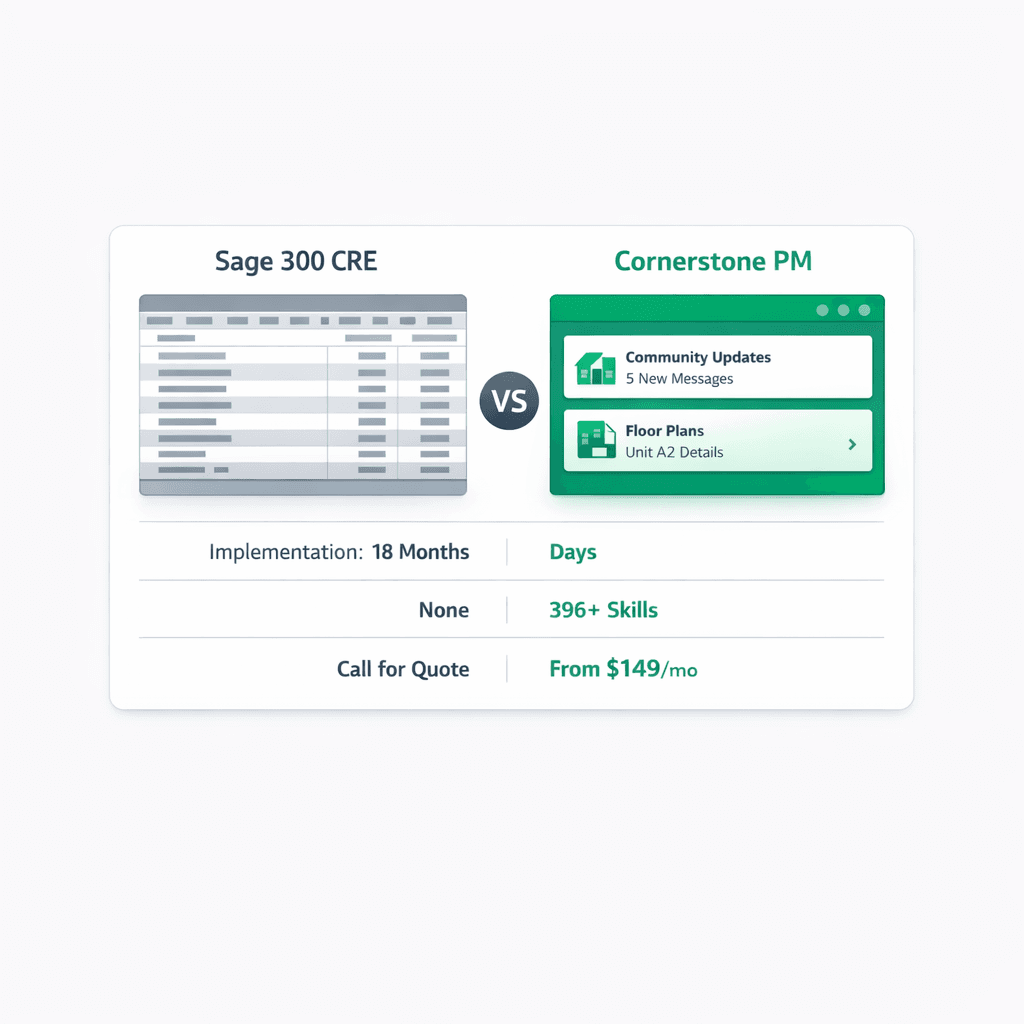
- Implementation timeline. Sage 300 CRE implementations routinely run 6–18+ months for mid-size deployments, with dedicated consultant hours and significant upfront configuration. A builder with active communities cannot absorb that runway.
How Cornerstone PM handles job costing for home builders
The core job-costing requirement for a home builder is different from a GC: builders need per-home and per-community P&L, tied to real vendor bid data and live purchasing records — not complex WIP schedules and AIA billing.
Cornerstone PM handles this through a direct one-way QuickBooks Online sync. Approved POs, change orders, bills, and vendors post automatically to QBO — with clean memos carrying community, lot, address, PO number, and cost code on every transaction. Each Community maps to a QuickBooks Customer (parent) and each Home maps to a Project (or a sub-customer Job on tiers without Projects), so builders get per-home and per-community P&L inside QuickBooks without restructuring their books.
The result: real job costing against the accounting system most small-to-mid builders already use, with zero double-entry and no ERP implementation. QuickBooks stays the source of financial truth; Cornerstone stays the source of operational truth.
AI capabilities: Sage vs. Cornerstone
Sage 300 CRE is not an AI-first platform. It has added reporting automation and some workflow tools over the years, but there is no AI agent layer, no construction-specific skill registry, and no blueprint takeoff capability.
Cornerstone PM ships five native AI agents as core platform capabilities — not paid add-ons, not bolt-on integrations:
- Foreman AI — 396+ construction skills across 20 categories. Reads and writes your live data: edits design options, updates vendor pricing, generates profitability reports and vendor scorecards, and runs multi-step purchasing workflows. Per-user and company-wide memory so it learns your business.
- Blueprint AI — reads a floor plan PDF and extracts 130+ material scopes and 3,284+ parts in under 60 seconds, eliminating manual takeoff.
- Bid Import AI — three import modes (takeoff-only, pricing-only, or both) with cross-scope accuracy penalties and replace-instead-of-duplicate logic on re-import.
- AI MLS Listing Generator — creates buyer-ready listing copy from your live floorplan and community data.
- AI Support Agent — platform help, around the clock.
Design center: a missing layer in Sage
For production home builders, the design center is not a peripheral feature — it is where buyers make decisions that directly affect the Master Cost Budget. Sage 300 CRE has no design center concept, which means builders running Sage have to manage buyer selections in a separate spreadsheet, separate software, or not at all.
Cornerstone's design center is fully integrated with purchasing and budgets:
- 64 Designer Packages across 7 categories auto-lock category options when a buyer picks a package style — a "Modern Farmhouse" pick completes the look without leaving a blank checklist.
- Exclusion groups — configure Carpet OR Tile OR LVP so one selection marks the flooring category complete.
- Spec-level upgrade pricing — promote any standard finish to a paid upgrade with one spec-level change. Granular control to the individual option, not just to the category.
- Option Classes — link buyer selections to scope items so a Premium cabinet choice flows directly to the cabinetry scope and the Master Cost Budget without re-keying.
Head-to-head at a glance
| Category | Sage 300 CRE | Cornerstone PM |
|---|---|---|
| Primary market | Large commercial GCs, subcontractors, real estate companies | Production and semi-custom home builders, 20–200 homes/year |
| Implementation | Months to a year+; dedicated controller, consultant fees | Days to weeks; AI migration wizard (~$0.01 per migration) |
| Stack | Accounting-first ERP, Windows-based, enterprise hosting | Modern web-native; works on any device, no installs |
| Job costing | Deep GL, WIP schedules, complex payroll/union accounting | Per-home and per-community P&L via one-way QuickBooks Online sync |
| AI capabilities | Not an AI-first platform | 5 native AI agents: Foreman (396+ skills), Blueprint AI, Bid Import AI, MLS Listing Generator, Support Agent |
| Design center | Not a production home builder tool; no design center layer | 64 Designer Packages, exclusion groups, spec-level upgrade pricing, Area Cost Pricing |
| Pricing | Enterprise / quote-based | Published: $149–$599/mo; Enterprise from $500/division/mo |
Pricing: enterprise opacity vs. published rates
Sage 300 CRE pricing is enterprise and quote-based. You can't get a number without going through a sales process — which is standard for ERP software but creates real friction when you're trying to evaluate total cost of ownership before committing months to a vendor conversation.
Cornerstone PM's pricing is fully published: Starter at $149/month, Builder at $249/month, Pro at $499/month, and Pro+ at $599/month with the full REST API, BYOA, and all 396+ Foreman skills. Enterprise multi-division starts at $500/division/month with a published volume discount at $450/division after five divisions. No discovery calls required.
Migration: $0.01 vs. a consultant engagement
If you're currently on Sage 300 CRE — or evaluating a switch — the migration question is real. ERP migrations typically involve a formal data-migration engagement: schema mapping sessions, data cleansing, parallel-run periods, and consultant hours that add up fast.
Cornerstone's AI-powered CRM Migration Wizard auto-detects your source platform and column mapping from a CSV or Excel export, then imports your data automatically — for roughly a penny per migration. It's designed to remove the switching cost that keeps builders locked into tools they've outgrown.
Who should still consider Sage 300 CRE?
This is a fair comparison, not a teardown. Sage 300 CRE is genuinely strong for what it was designed to do: heavy GL, WIP, AIA billing, union payroll, and multi-entity accounting for large commercial GCs and real estate operations.
If you're a $300M+ commercial general contractor with a full accounting department, complex union payroll requirements, and enterprise integrations with lenders and bonding companies, Sage 300 CRE may still be the right category. But if you're a production home builder running 20–200 homes per year across one to a dozen communities, the ERP model imposes a layer of complexity — and a price tag in time and money — that doesn't match the problem you're actually solving.
The modern home builder platform pairs with the QuickBooks Online you already have for job costing, runs communities from day one, and ships an AI agent that does the purchasing work your team was doing by hand. That's a different product category than a construction ERP — and for most residential builders, it's the right one.
Ready to run without the ERP overhead?
Cornerstone PM gives production home builders real job costing, a full design center, and five native AI agents — without the implementation timeline or enterprise price tag.
Request Early Access