Signed Construction Webhooks: Verify the Sender Before Automating Work
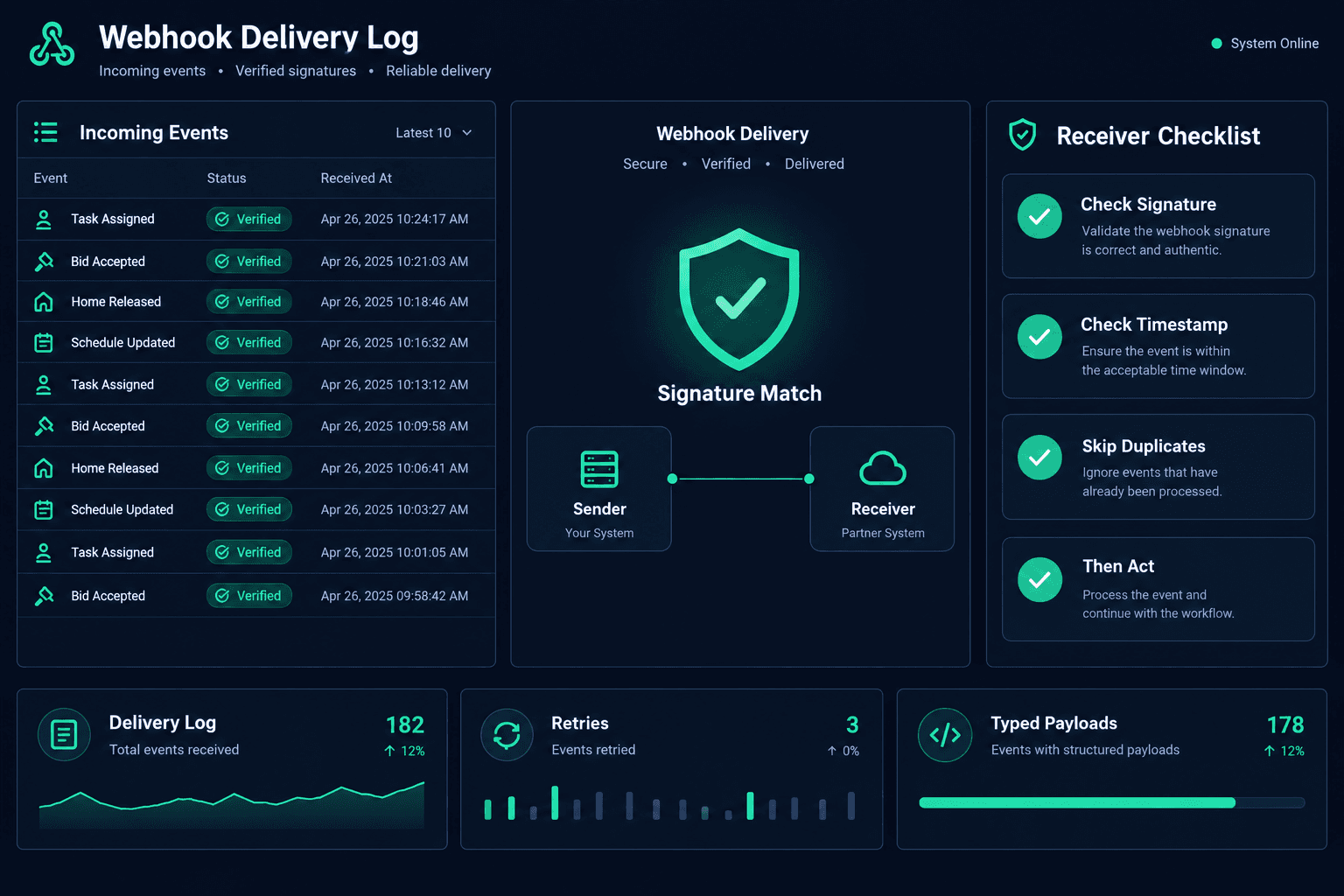
Verify the signature on every incoming webhook before your automation sends a message or changes another system. A signature is how a receiver knows the request really came from the sender and was not altered on the way.
Cornerstone PM's Foreman AI platform supplies signed events, typed payloads, delivery logs, and automatic retries across 37 named webhook events. The signing half is ours. The checking half lives in your receiver, and it is easy to skip when everything works in testing.
Why verify a webhook before automating anything?
A webhook endpoint is a public URL. Anyone who finds it can send it a request that looks like a Cornerstone PM event: a task assigned, a bid accepted, a home released. If your receiver trusts the shape of the request alone, a forged one can trigger a text to a subcontractor, a voice call, or an update in your CRM.
Verification puts a gate in front of that work. Nothing downstream runs until the request proves it was signed with the secret you registered for the webhook.
What does Cornerstone PM sign, and what does your receiver check?
When you register a webhook, you provide a secret. Each delivery is signed with HMAC SHA-256 using that secret, and the signature travels in the X-Webhook-Signature header. The full reference is in our API and webhook documentation.
Cornerstone supplies
Signed events, typed payloads, delivery logs, and retries with a logged response for each attempt.
Your receiver must do
Recompute the signature, compare it to the header, and reject anything that does not match before acting.
Cornerstone cannot verify on your behalf. If your integration never checks the header, the signature protects nothing.
What should a receiver review before acting on an event?
- Verify against the raw body. Recompute the signature over the exact bytes received, before any parsing or reformatting.
- Reject on mismatch. Return an error, run no automation, and log the failed attempt.
- Keep the secret out of source code.Store it in your receiver's secret management and rotate it if it leaks.
- Check for duplicates. Retries are normally signed too, so use the event ID to avoid acting twice.
- Act last. Send the message or update the other system only after every check above passes.
What does a valid signature not guarantee?
A valid signature is narrower than it sounds. It does not encrypt the payload, so use an HTTPS endpoint and treat logs carefully. It does not guarantee exactly-once delivery, because a retried event arrives with a fresh, valid signature. And it does not secure the rest of your receiver or the third-party services it calls.
When something looks wrong after a verified delivery, the delivery log is the next place to look. We walk through that in tracing a failed webhook delivery, and the event catalog is covered in the 37 webhook events overview.
How do you test the check before relying on it?
Send your receiver one request with a wrong signature and one with a body changed by a single character. Both should be rejected with no downstream action. Then confirm a real delivery from your registered webhook passes. Testing only the happy path leaves the part that matters unproven.
Signed delivery gives your team a reliable way to know who sent an event. Pairing it with a receiver that checks before acting is what turns Foreman AI automation into something you can trust with real work.
Automate builder workflows on events you can verify.
Cornerstone PM ships signed webhook events with typed payloads, delivery logs, and retries, so your integrations have something solid to build on.
Request Early Access