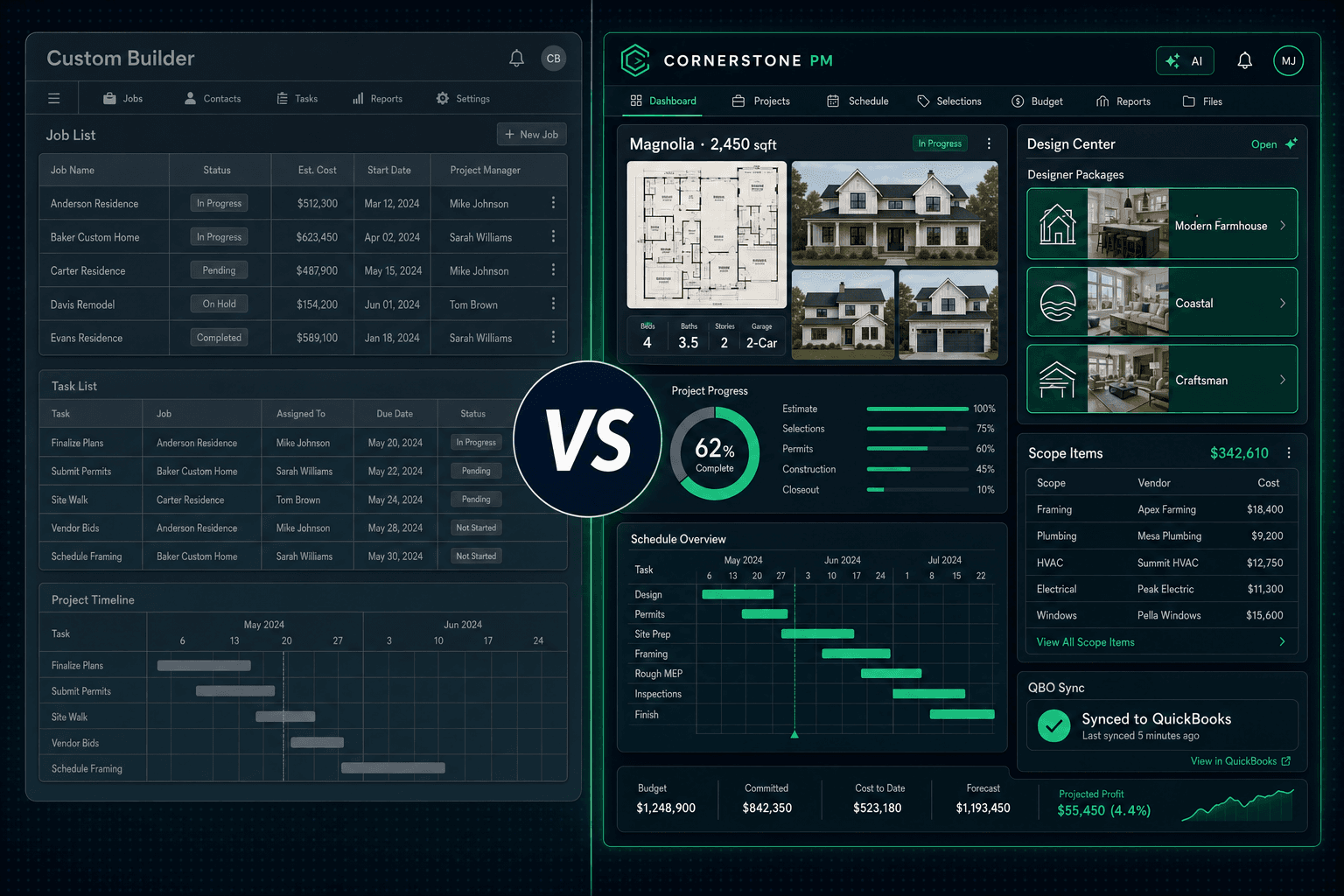
UDA ConstructionOnline vs Cornerstone PM for Production Builders
UDA ConstructionOnline is a strong, mature platform — for custom home builders and remodelers who estimate one job at a time. Production home builders who repeat the same floorplans across communities need a different architecture entirely, and that difference runs deeper than a feature checklist. Cornerstone PM is built for production builders — where a floorplan is a reusable object, not a fresh estimate.
This is a fit question, not a teardown. If you build custom homes or manage remodels where every job is unique, UDA ConstructionOnline may be exactly what you need. If you build the same plans repeatedly, what follows explains why that distinction matters for every part of your operation — from how selections are priced to how costs flow into your books.
The core difference: job-centric vs. plan-centric
UDA ConstructionOnline's architecture is job-centric. Each project is a standalone estimate — you build a cost plan for a specific house, for a specific client, at a specific address. That is the right model for a custom builder or remodeler. The cost of that Craftsman bungalow is genuinely different from the cost of the Tudor next door, and the software reflects that.
A production home builder works differently. The Magnolia plan has a fixed set of structural options, and you've sold it 87 times across four communities. The framing labor rate for Magnolia is the same in every community — or it's different because Vendor A won Community A and Vendor B won Community B. You don't re-estimate Magnolia for every start; you apply the plan and let the platform handle the repricing.
Cornerstone PM is built around that repetition. Floorplans are first-class objects with their own scope items, structural options, and vendor pricing. Change the framing labor rate once and it updates across every home of that plan in every community. A job-centric tool can't do that — each start is a fresh copy, and updates don't propagate.
Feature comparison
Why does design center architecture matter so much?
For a custom builder, design selections are per-job allowances: the client picks finishes, the builder marks them against a line item on that project's budget, and the job closes. That's a reasonable model when every home is different.
A production builder sells the same Magnolia plan to 20 buyers in one community. Every buyer needs to pick from the same option set — flooring, countertops, cabinets, exterior colors. The right design center doesn't re-enter those options for each buyer. It prices them once at the floorplan level and reuses them across every sale.
Cornerstone PM's production design center goes several steps further. Spec levels give builders granular included-vs-upgrade control down to a single option: promote any standard finish to a paid upgrade with one spec-level change, and it drops out of the base price immediately across every home of that plan. Exclusion groups make conflicting selections structurally impossible — a buyer picks flooring once (Carpet or Tile or LVP or Hardwood) and the category marks complete, rather than leaving all four as dangling “incomplete.” And 64 curated Designer Packages across 7 categories let buyers start with a coordinated look — Modern Farmhouse, Coastal, Craftsman — that auto-locks all the category options for that style, shortening the selections cycle dramatically.
Takeoff: re-estimating every start vs. reading the plan once
UDA ConstructionOnline integrates with third-party takeoff tools. For a custom builder who estimates a different scope every time, that model is reasonable.
A production builder running the Magnolia plan across 50 starts doesn't need to re-read the dimensions on every permit set. But when the plan is revised — a structural option changes, a bedroom is moved — the takeoff needs to update everywhere that plan is used.
Cornerstone PM's Blueprint AI extracts 130+ material scopes from a floor plan PDF in under 60 seconds — room detection, fixture counts, dimension parsing, material scope mapping — and prices them against accepted vendor bids. Because the takeoff lives at the floorplan level, not the job level, updating a plan re-prices every future start instantly. The math runs once; the platform handles the rest.
Vendor pricing: per-job negotiation vs. community-assigned awards
Custom builders typically negotiate vendor pricing job by job. That's appropriate when each scope is genuinely different.
Production builders leverage volume. One framing contractor wins all of Community A at a negotiated rate; a different framing contractor wins Community B. Once awarded, that rate applies to every home in that community automatically — no re-bidding per start, no manual re-entry.
Cornerstone PM's bidding workflow supports this exactly. A bid request goes to multiple vendors with auto-generated, scope-filtered Excel templates. Vendors submit through a no-login portal. Bids are compared side-by-side and awarded by community. Once awarded, pricing locks — neither the builder nor the vendor can quietly revise the number. Every downstream scope item and budget line traces back to that locked, awarded price under the hard-cost rule: nothing carries a stored or default cost, so a line with no accepted bid shows as $0 / needs pricing rather than an invented number.
Accounting: job-level job costing vs. per-home P&L in QuickBooks
UDA ConstructionOnline provides job costing within the platform. For a custom builder, that's typically sufficient — each project has its own P&L and the builder can see where they are on that job.
Production builders often need their margins inside QuickBooks Online, where the bookkeeper, the CPA, and the bank all live. Cornerstone PM syncs one-way to QuickBooks automatically: approved purchase orders, change orders, bills, and vendors post themselves to QBO with no CSV exports or double-entry. Each Community maps to a QuickBooks Customer (parent) and each Home maps to a Project, so builders get real per-home and per-community P&L inside QuickBooks without any manual journal entries.
Cornerstone stays the source of truth — changes in QuickBooks never overwrite it, and every synced transaction carries a clean memo (community, lot, address, PO number, cost code) so any QuickBooks transaction is traceable back to the exact home and trade.
The AI layer: answers vs. actions
Most construction software has added AI features in the past two years. The meaningful distinction is between a chatbot that answers questions and an agent that takes actions inside the platform.
Cornerstone PM's Foreman AI has 396+ skills across 20 categories that read and write real data. It creates area costs, updates vendor pricing, generates scope-of-work documents, analyzes jobsite photos with AI vision, and runs multi-step purchasing workflows without anyone opening the purchasing screen. Foreman also carries per-user memory — it learns each team member's vendor preferences, communication style, and builder defaults across sessions, so it gets more useful over time rather than resetting every conversation.
The difference matters most during high-volume periods: a superintendent who needs 40 scope items repriced after a plan revision, or a purchasing manager who needs bid request status across 12 vendors in 3 communities, gets answers and completed actions in seconds rather than working through the UI manually.
Which platform is the right fit?
If you build custom homes or remodel projects — where every job has its own scope, its own client negotiation, and its own estimate — UDA ConstructionOnline is a mature platform worth evaluating seriously. It handles the job-centric model well.
If you build the same floorplans repeatedly — selling the Magnolia or the Heritage across communities, running the same trades at community-awarded rates, and needing buyer selections managed at the plan level rather than job level — Cornerstone PM is built for that shape of business. The platform-level repetition tooling (plan-level takeoffs, Designer Packages, community vendor awards, auto-generated POs on task completion, one-way QuickBooks sync) doesn't exist in a job-centric tool because it can't — the architecture would have to be rebuilt from the ground up.
Builders who are being pushed to migrate from CoConstruct or ConstructionOnline to a Buildertrend-family tool are in a similar position: that migration will land them on another custom-builder tool. If the business model has shifted toward production and plan repeats, that move doesn't solve the problem.
Built for builders who repeat floorplans, not just build houses.
Plan-level takeoffs, Designer Packages, community vendor awards, and one-way QuickBooks sync — purpose-built for production home builders. See how Cornerstone PM fits your operation.
Request Early Access