One Trade, Different Communities: Assigning the Right Vendor to Every Job
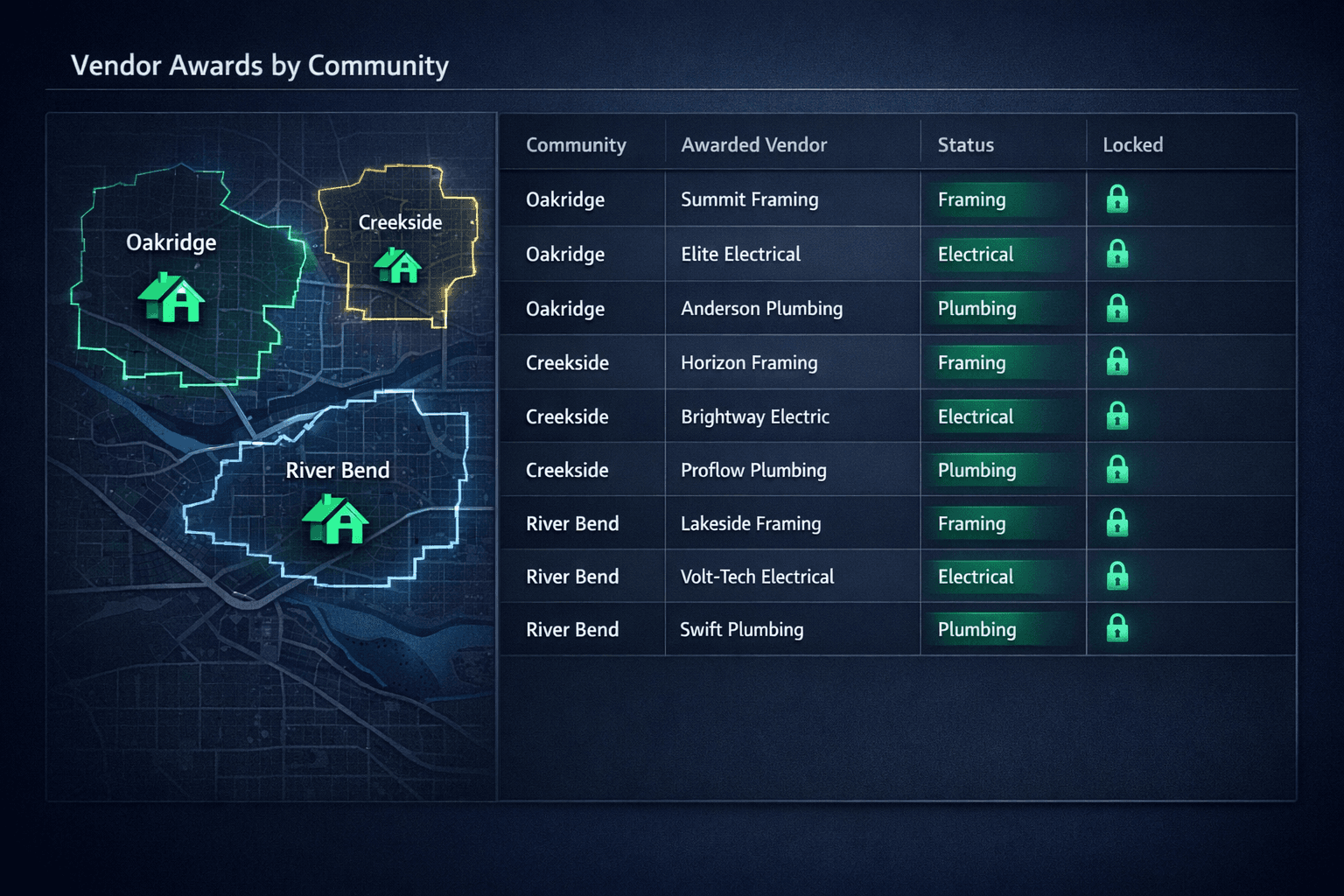
The best framing crew for one community isn't always the best framing crew for another. Cornerstone PM's purchasing module lets builders hold multiple accepted bids for the same scope — each tied to its own community — so accepted pricing follows the correct vendor into every budget and purchase order without manual overrides.
Lowest-bid-wins-everything logic assumes a single vendor should serve a builder's entire footprint. That assumption rarely survives contact with more than one community. A vendor who's efficient and well-priced twenty minutes from their shop can be the wrong choice for a community an hour away — not because their work is worse, but because travel time, crew capacity, and local familiarity all change the economics of the job.
What does community-specific vendor assignment actually solve?
It separates “who quoted the lowest price” from “who should actually do this work.” A builder running several active communities at once needs a way to award the same trade to different vendors without one award overwriting or conflicting with another — and without losing track of which accepted price applies where.
Service area, not just service quality
A vendor can be excellent and still be the wrong choice for a specific community if it sits outside their realistic travel range. Awarding by community lets a builder route work to whoever can actually show up on schedule, not just whoever quoted the lowest number.
Multiple accepted bids, same scope
Framing in Oakridge and framing in River Bend are the same trade but two different awards. Cornerstone PM holds both as separate accepted bids tied to their own community, so neither award has to yield to the other.
Pricing stays attached to its community
Once a bid is awarded and locked for a community, that price is the cost basis for every home in that community — and only that community. A different community's accepted price never bleeds into the wrong budget.
What generic bid systems get wrong
Tools built around a single company-wide lowest-bid winner assume one vendor should cover every job. That assumption breaks the moment a builder operates in more than one community — which is most production builders.
How does an accepted price stay attached to the right community?
When a bid is awarded in Cornerstone PM, the award record ties three things together: the vendor, the scope, and the community. That combination — not the vendor or scope alone — is what determines which accepted price a budget line or purchase order pulls from. Oakridge's framing award and River Bend's framing award both exist as separate, fully locked records. Neither one has to be dominant; both stay accurate at the same time.
That matters because a builder's Master Cost Budget is built per community and per floorplan. If the platform only tracked one accepted price per scope company-wide, every community would either share a vendor that doesn't actually serve all of them, or someone would have to manually override the budget line by line to reflect reality. Community-specific awards remove that manual step entirely.
What happens when a purchase order is generated?
A purchase order for a lot in Creekside pulls the vendor and locked price that were awarded for Creekside — automatically, with no lookup or manual selection required. There's no risk of a PO defaulting to whichever vendor happens to be cheapest company-wide, and no risk of a vendor receiving a purchase order for territory they were never awarded. The community assignment travels with the award from the moment it's locked all the way through to the purchase order.
Why does this protect trade relationships instead of just protecting price?
Vendors who know they're re-competing against the whole market on every bid cycle have little reason to prioritize a specific builder over anyone else. A vendor who knows they hold a specific community — and that the award won't evaporate the moment a cheaper number shows up somewhere else in the pipeline — has a real incentive to protect the relationship: showing up on schedule, communicating early on delays, and treating the builder's crews as a priority rather than one more job on the list.
That reliability compounds. A trade partner who has worked a specific community for several seasons knows the site conditions, the inspectors, and the other crews already on-site. Ripping that up every time a lower bid appears elsewhere in the company trades a known quantity for an unknown one — often over a difference that doesn't survive a single missed start date.
How does this avoid awarding work outside a vendor's service area?
Because each award is scoped to a specific community rather than the scope of work in general, a builder never has to force a vendor into territory they don't actually want or can't reliably cover. If a vendor tells a purchasing team they only serve the north side of a metro, that constraint is respected by simply not awarding them the south-side community — instead of trying to negotiate an exception into a single company-wide contract.
Once awarded and locked, that community-specific price becomes the real cost basis for every home built there — not an estimate, and not a number borrowed from a different community with different conditions.
How does this fit the rest of the purchasing workflow?
Community-specific awards are one step in the same connected chain covered in Cornerstone PM's purchasing workflow: bid request, vendor response, comparison, award, budget update, and purchase order. The only difference is that the award step can produce several valid, simultaneous outcomes — one per community — instead of a single company-wide winner. Every one of those outcomes still flows through the same locking and budget-update logic once it's accepted.
For a broader look at how purchasing fits the full platform, see the home builder project management software overview.
Award the right vendor to every community, not just the cheapest one.
Cornerstone PM's purchasing module holds multiple accepted bids per scope, ties each to its community, and carries the locked price straight through to every purchase order.
Request Early Access