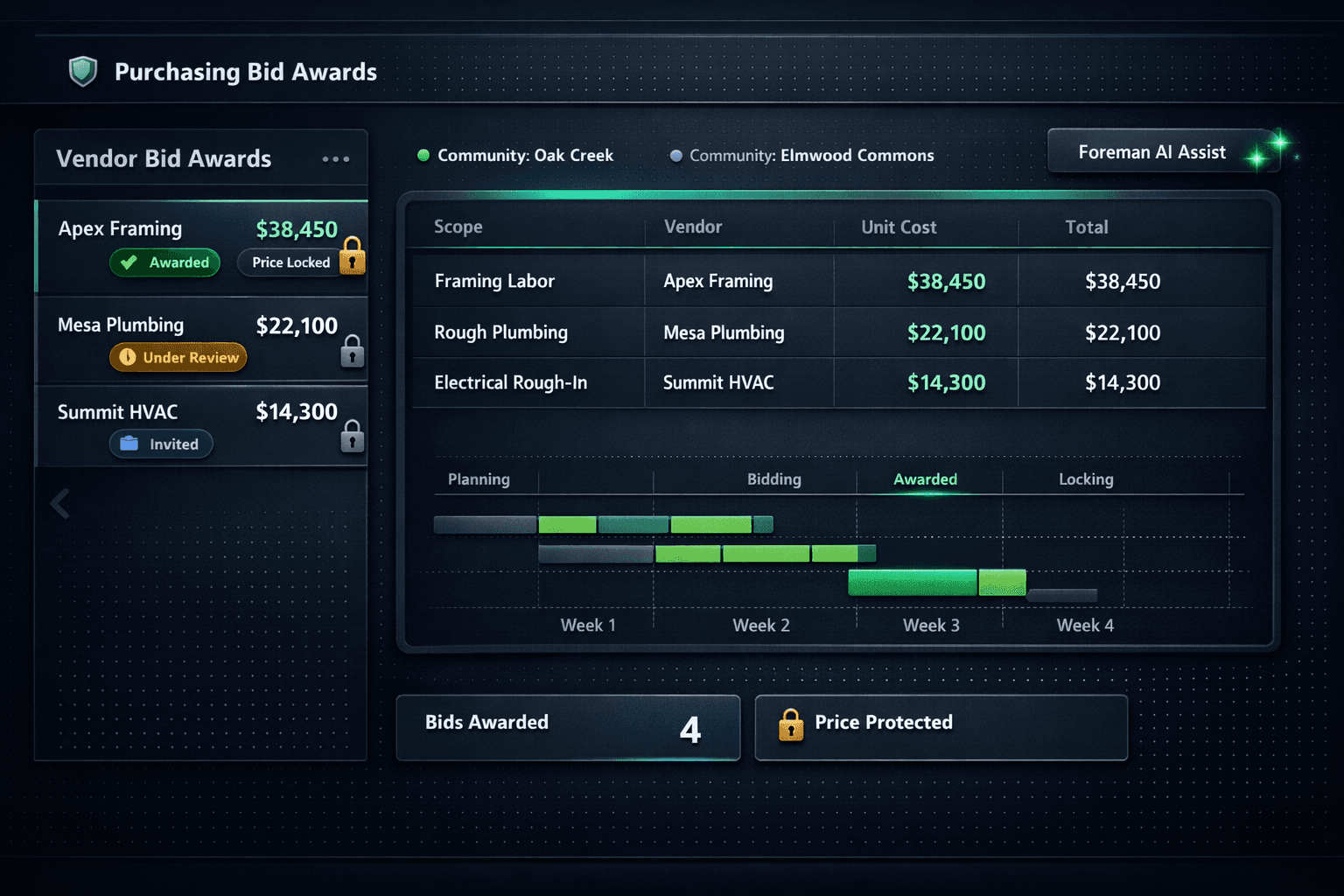
Lock the Price After Award: Protecting Vendor Bids From Cost Drift
Once a vendor accepts an award, the price should be a record — not a suggestion. Cornerstone PM's purchasing module locks awarded bids so neither the builder nor the vendor can revise the number after acceptance, turning an agreed quote into a durable cost basis for every downstream budget line and purchase order.
Cost drift is a quiet margin killer. A framing sub submits $38,450 in April, the builder awards it, and by the time the homes start in June the number has crept to $41,200 — through informal conversations, a new material surcharge email, or simply a misremembered figure on both sides. Without a locking mechanism, the original award is just an email with no enforcing power.
Bid Awards — Oak Creek Community
Apex Framing
Framing
Blue Ridge Electric
Electrical
Summit HVAC
HVAC
Awarded bids lock automatically — neither builder nor vendor can edit the price after acceptance.
Why does an accepted quote need to be locked?
An awarded bid without a lock is still a negotiation. Vendors know that builders are reluctant to restart a bid process mid-schedule, so a “small adjustment” after award carries very little risk for the sub. Builders, for their part, often accept the creep quietly because disputing it feels like damaging the relationship.
The solution is not better negotiation — it is making the lock automatic and explicit. When a builder awards a bid in Cornerstone PM, the pricing freezes at that number. Both parties can see the locked record. The conversation that used to happen in an email thread now has a platform-enforced counterpart: the agreed price is a timestamped record, not a shared memory.
How do community-based awards keep pricing organized?
Production builders rarely use the same vendor in every community. The framing crew that won Oak Creek at $4.10 per square foot may not have been competitive in Elmwood Commons, where a different crew came in at $3.85. Both awards need to be active, traceable, and locked simultaneously — and they need to feed separate community budgets without confusing each other.
Cornerstone PM awards bids per community. Each community carries its own accepted pricing, its own locked vendor record, and its own cost basis feeding the Master Cost Budget for that location. A builder can hold multiple accepted bids on file across different geographies or schedule windows without any of them interfering.
How does a locked bid connect to the rest of the budget?
A locked bid is not an isolated record — it is the source of truth for every downstream cost that references that scope. Under Cornerstone's hard cost rule, nothing carries a stored default or estimator-fudged number — every dollar traces back to accepted vendor pricing. A scope item with no awarded bid shows as $0 / needs pricing rather than inheriting a fabricated placeholder.
The practical consequence: when framing locks at $38,450 in Oak Creek, every framing cost on every lot in that community immediately reflects that number. Purchase orders generated from completed schedule tasks carry the locked price. QuickBooks receives the synced PO with the correct figure. There is no second opportunity for the number to drift between the award and the check.
The lock-to-PO chain
Bid awarded and locked → accepted pricing feeds the Master Cost Budget → task completes → purchase order auto-generates at the locked price → PO emails the vendor → PO syncs to QuickBooks as a commitment. No re-keying, no opportunity for the number to change between steps.
What does a locked bid mean for dispute resolution?
Every construction project eventually produces a conversation that starts with “I thought we agreed on…” Locked bids make that conversation short. The platform record shows the exact submitted amount, the award timestamp, and the community the award applies to. Neither party can edit it retroactively.
For builders, this removes the need to search email threads for the “real” number before a dispute. For vendors, it provides the same certainty: the awarded price is the price they will invoice against, and no informal conversation at the job site can quietly revise it downward after the fact. The lock benefits both sides.
What if a re-bid is needed?
Locked bids represent what was agreed for a specific award. If market conditions shift — a lumber spike, a sub's capacity change — the right mechanism is a formal new bid or change order for the next community or the next phase of work. The original award stays intact as the historical record.
This separation — locked history on one side, new bids for new work on the other — is what keeps the audit trail clean across a multi-community, multi-phase build program running through several market cycles. The purchasing module is designed around this structure: bid requests, awards, locks, POs, and the QuickBooks sync form a chain where every step traces to the one before it.
Lock your vendor pricing before it drifts.
Community-based vendor awards, automatic bid locking, and a hard-cost rule that traces every budget dollar to an accepted bid — all in Cornerstone PM's purchasing module.
Request Early Access