Replacing a Subcontractor Mid-Build: Separate Finished Work From the New Scope
When a subcontractor can't finish a home, document exactly what they completed, define the remaining scope in writing, and review existing purchase orders before bidding out and assigning the rest of the work — swapping the vendor assignment alone doesn't settle anything that came before it.
A trade walking off a job mid-build isn't rare — a sub overextends across too many communities, a crew leaves the business, quality falls apart, or a relationship just breaks down. However it happens, the risk isn't finding a new vendor. It's losing track of where the old work ends and the new work begins, which is exactly how a home's budget and schedule both quietly go sideways.
Why is the handoff itself the risky part?
Replacing a trade is usually the easy part — there's almost always another framer, plumber, or electrician willing to take the work. The hard part is drawing a clean line between what the outgoing vendor actually finished and what the incoming vendor is being asked to do. Skip that step and you end up either paying twice for the same work or leaving a gap neither vendor accounted for.
It gets messier when the home has multiple purchase orders already issued to the outgoing trade — partial draws, deposits, or material already delivered. None of that disappears just because a new vendor is picking up the remaining work.
Finished Work
What's documented, walked, and already billed under the outgoing vendor's existing purchase orders — a separate record from anything going forward.
Remaining Scope
What's left to complete, written down and bid out fresh to the incoming vendor — scoped to exactly what's outstanding, not the full original job.
What should happen before a single new bid goes out?
Walk the home and write down what's actually complete versus started-but-not-finished. Then pull every purchase order already issued to the outgoing vendor for that home and review them — separately from whatever happens with the new trade. Assigning a different vendor going forward does not automatically rewrite those existing POs or settle the original contract; that's its own process, worked through on its own terms.
Only once the finished work is documented and the existing commitments are accounted for should the remaining scope get written down and sent out for pricing.
How should the remaining scope get bid and awarded?
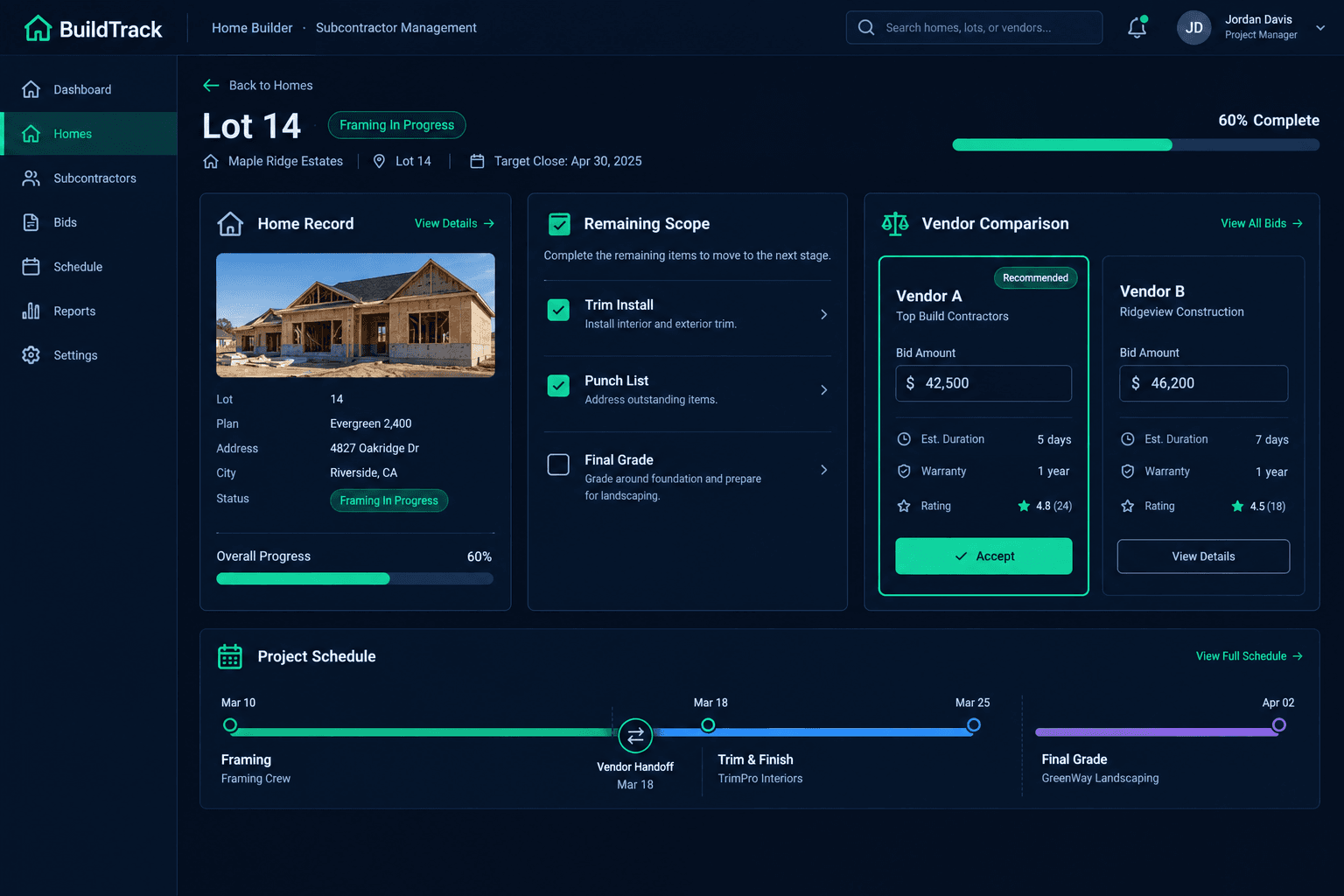
Send a scope-based bid request to vendors who can pick up the trade, limited to exactly what's left on that home. Compare the responses side-by-side before accepting pricing — the accepted price becomes the incoming vendor's commitment for the remaining scope, tracked as its own record rather than folded into whatever the outgoing trade was paid.
Once pricing is accepted, assign the new vendor to the community so they're available for this home and any others in the same phase, and set the next scheduled date for them to take over the trade.
Cornerstone keeps the records separate — the review is still yours
Cornerstone's scope-based bid requests, side-by-side bid comparisons, and community vendor assignments give you a clean way to price and award the remaining scope without disturbing the outgoing vendor's existing purchase orders. Cornerstone does not automatically rewrite issued POs, settle the original contract, or calculate a backcharge — documenting completed work and reviewing existing commitments stays a human step, same as the vendor change itself.
What keeps the linked schedule from falling apart?
Downstream trades plan around a start date, not a vendor name. Once the handoff date is set for the incoming vendor, confirm the home's linked schedule reflects it so the next trade in line isn't waiting on a date tied to the vendor who's no longer on the job. That one update is what keeps a single subcontractor swap from rippling into a scheduling problem for the rest of the build.
None of this replaces a conversation with your attorney if the original contract needs to be formally terminated, and none of it calculates what, if anything, should be backcharged to the outgoing vendor — those are separate decisions. What this checklist protects is simpler: a clean line between finished work and new scope, so the home's budget and schedule stay accurate through the transition. For the full build workflow this handoff sits inside, see Cornerstone PM's construction module.
Keep every vendor swap tied to the right scope.
Cornerstone PM links purchase orders, bids, and schedules to each home, so replacing a subcontractor mid-build never loses track of what's already done.
Request Early Access