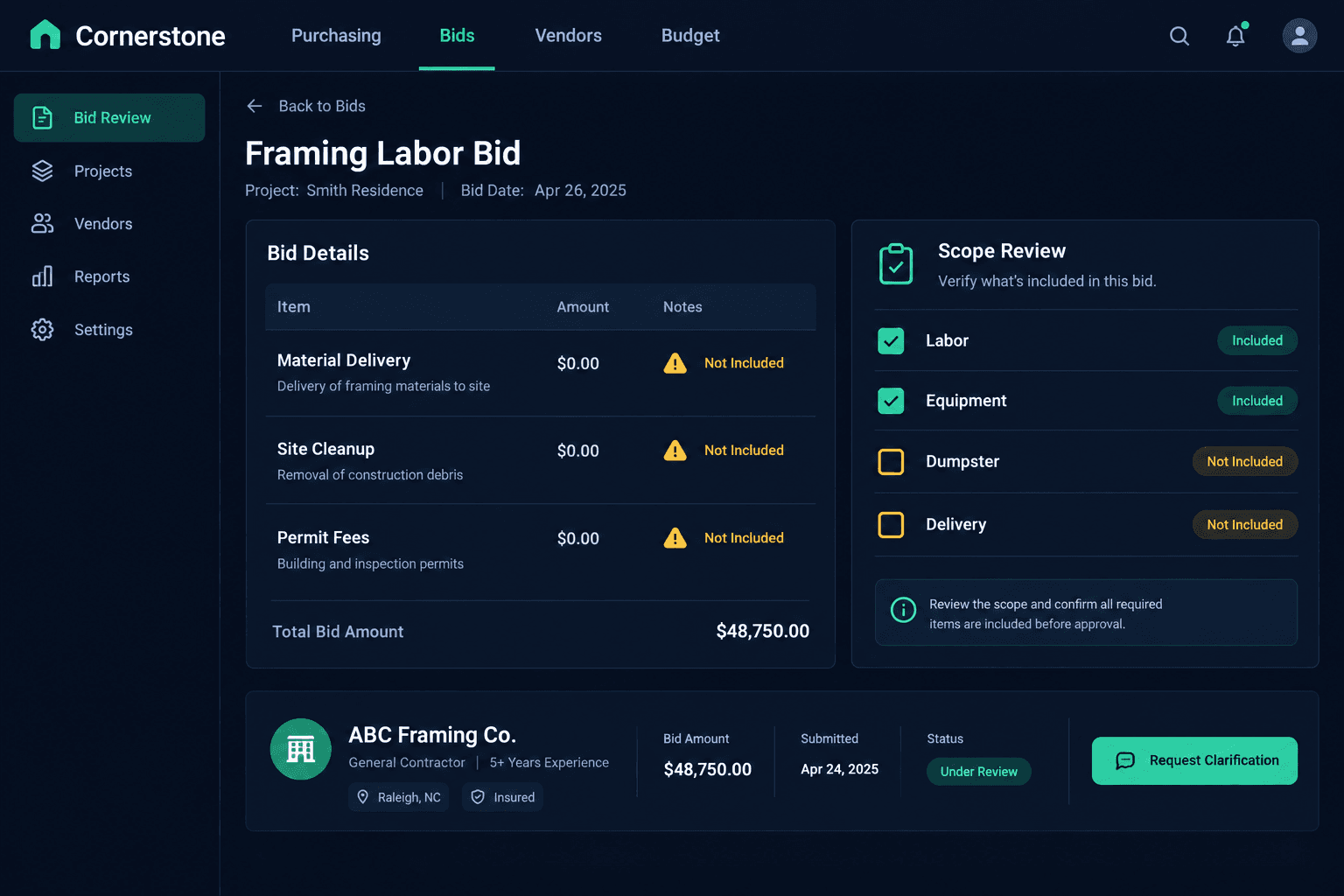
The Bid Looks Complete: Check What the Subcontractor Left Out
A subcontractor bid can have every line item priced, a reasonable total, and still leave material delivery, equipment rental, or site cleanup out of scope entirely. Reading the quote's notes and terms — not just the bottom-line number — before accepting a bid is what catches exclusions before they turn into an unplanned cost mid-build.
Exclusions aren't a sign of a bad vendor. Most subcontractors quote exactly the scope they intend to perform, and leave everything else to whoever asks. The gap only becomes a builder's problem when nobody checks whether the full scope — delivery, equipment, cleanup, disposal, permits — actually has an owner across every vendor on the home.
What does a hidden exclusion actually look like?
Take a framing labor bid that reads clean at first glance: a price per line item, a subtotal, a total. Buried in the notes or a line marked "by others," the quote excludes material delivery, site cleanup, and permit pickup. None of those are priced at zero because they're included — they're priced at zero because the vendor never intended to cover them. If no one reads past the total, that gap doesn't surface until a dumpster never shows up or a delivery truck gets turned away at the gate.
The same pattern shows up across trades. A roofing bid that excludes dump fees. A plumbing bid that assumes someone else pulls the permit. An electrical bid priced "material and labor" that turns out to mean labor only, with material supplied by the builder. Each one is a normal, defensible way for a vendor to scope their price — as long as the builder catches it before award, not after.
Missing From the Quote
Not mentioned anywhere in the bid, or noted as "by others." A missing line is not a confirmed inclusion at zero cost — it's an open question.
Confirmed In Scope
The vendor has stated in writing that the item is included in the accepted price. That confirmation is what makes the scope reliable, not the absence of an objection.
How do you build the expected scope list before reading a bid?
Start from the trade, not the quote. Before opening a subcontractor's number, write down what that scope normally includes on this home: labor, material delivery, equipment, cleanup, disposal, and any permits tied to the work. Cornerstone's scope-based bid requests carry that expected scope into the request itself, so the vendor is responding to a defined list rather than quoting whatever they assume is standard. That gives the reviewer a fixed checklist to compare the incoming quote against, instead of trying to remember everything a trade "usually" covers.
Once the expected list exists, the review becomes a comparison exercise: for each item on the list, is it priced in the quote, confirmed excluded and owned elsewhere, or simply absent? Only the first two are resolved. An absent item is still open.
What's the right way to ask a vendor about a gap?
Ask directly, and ask for a written answer. "Is material delivery included in this price, or is that the builder's responsibility?" is a question most subcontractors can answer in one line. The goal isn't to catch the vendor in an error — it's to get the scope boundary stated clearly enough that it doesn't need to be re-litigated mid-build. Vendor document uploads and notes attached to the bid record give that clarification a home, so the answer travels with the quote instead of living in a separate email thread.
When two or more vendors are bidding related trades on the same home — framing and cleanup, roofing labor and roofing supply — a side-by-side comparison is the fastest way to spot a scope item that nobody actually owns, or one that two vendors have both silently assumed the other covers.
Cornerstone doesn't auto-detect exclusions
Cornerstone PM gives the reviewer the scope request, the vendor's quote, and any uploaded documents side by side, but reading for exclusions and resolving them with the vendor is still a human judgment call — the same way it would be reviewing a paper bid.
Does a zero-cost line always mean the work is included?
No, and treating it that way is the most common version of this mistake. A line item with no dollar amount next to it can mean three different things: it's genuinely included at no added cost, it's excluded and the vendor simply didn't include a row for it, or it's an allowance placeholder waiting on a later decision. Those are not interchangeable, and a reviewer who assumes "no cost listed" means "included" is the reviewer who finds out otherwise once the trade is on site.
Once a bid is accepted, Cornerstone PM carries that price into the budget as the hard cost for the scope — there's no later estimating step that re-checks whether delivery or cleanup actually made it into the number. Resolving exclusions before award is what keeps the accepted price trustworthy once it's locked in.
The review itself doesn't require new tooling, just reading the quote's notes with the same attention as its total and asking one direct question when something's missing. For the full purchasing workflow, from bid request through accepted price, see Cornerstone PM's purchasing module.
Stop finding out what a bid excluded after the trade shows up.
Cornerstone PM keeps scope requests, vendor quotes, and clarification notes together, so accepted pricing locks into the budget with the scope already confirmed.
Request Early Access