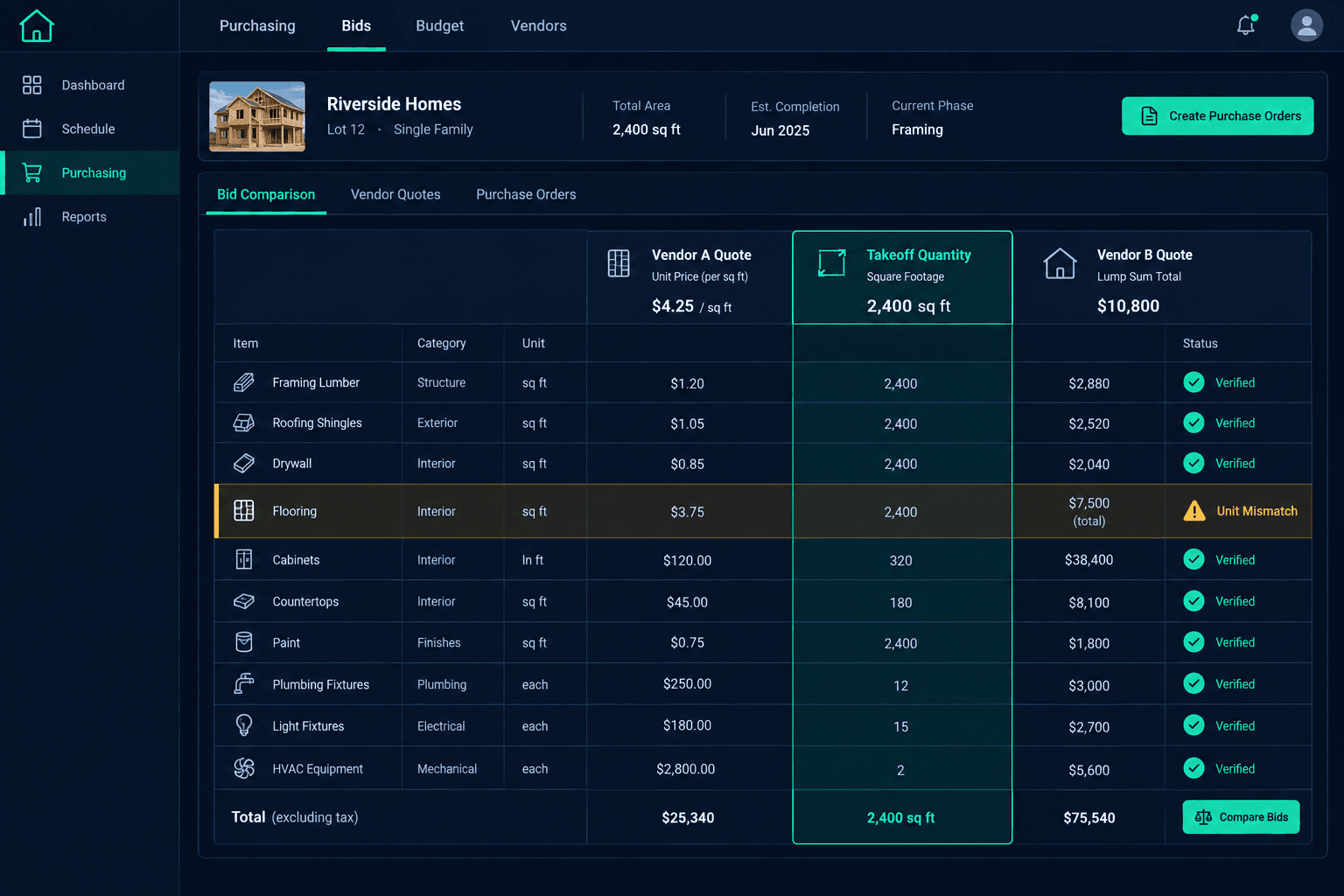
Square Feet or Whole-House Price? Catch Unit Mismatches Before Awarding a Bid
Two vendors can quote the exact same scope of work in two completely different units — one per square foot, one as a single whole-house price — and both numbers can look reasonable in isolation while being wrong relative to each other. Checking the vendor's quoted unit against the takeoff quantity before award is the step that catches this, and it belongs in every purchasing coordinator's bid review workflow.
Unit mismatches aren't a software bug or a vendor trying to be deceptive — they're just how quoting naturally happens across different trades and different company sizes. A regional flooring supplier who stocks by the roll thinks in price per square foot. A local cabinetry shop that builds one job at a time thinks in a single number for the whole house. Both are valid ways to quote. The problem only shows up when a builder compares them without converting one to match the other first.
What does a unit mismatch actually look like on a real bid?
Take a flooring scope on a 2,400 square-foot home. Vendor A quotes $4.25 per square foot. Vendor B quotes $9,600 for the whole job. At first glance those look like two numbers in the same ballpark — until you do the math: Vendor A's per-square-foot rate multiplied against the 2,400 square-foot takeoff comes to $10,200, not $9,600. That's a hypothetical example, but the shape of the error is common: a builder reads the smaller number and assumes it's the cheaper bid, without confirming the unit each vendor actually priced against.
Trim carries the same risk in linear feet instead of square feet. A vendor quoting $1.80 per linear foot on a home with 340 linear feet of baseboard comes to $612 — a number that means nothing next to a competing vendor's $2,400 lump-sum quote for the same trim package unless both are read against the same takeoff quantity.
Quantity-Multiplied
Priced per square foot, per linear foot, or per unit. Multiply the vendor's rate by the takeoff quantity to get a comparable total before evaluating the bid.
Lump Sum
A single price for the entire scope, already accounting for quantity. Multiplying it against the takeoff again inflates the number several times over.
How does a purchasing coordinator compare quotes in different units?
Start with the takeoff, not the quote. Every scope item on a floorplan has a quantity behind it — square footage for flooring and paint, linear footage for trim and gutters, a unit count for doors and fixtures. Pull that number first, then read each vendor's quote against it. A per-square-foot rate gets multiplied by the takeoff quantity; a lump-sum quote stands as written. Doing the multiplication before comparing bids — rather than comparing the raw numbers on the page — is what turns two differently formatted quotes into a real side-by-side comparison.
This matters most when the two vendors on the same scope quoted in different formats — one per square foot, one lump sum. Without converting both to the same basis, a coordinator is effectively comparing two different kinds of numbers and treating them as equivalent.
What should trigger a request for vendor clarification?
A few situations are worth a quick note back to the vendor before award rather than an assumption: the quote doesn't state a unit at all, the stated unit doesn't match how the scope is normally priced for that trade, or the total doesn't reconcile when the coordinator does the math against the takeoff quantity. None of these mean the vendor made a mistake — they usually mean the quote needs one clarifying reply confirming what basis the price was built on. That reply, in writing, is worth having before the bid is accepted.
Cornerstone doesn't auto-convert or flag unit mismatches
Cornerstone PM shows the takeoff quantity and the vendor's quoted price side by side, but reading the vendor's unit and doing the comparison is still a manual step for the purchasing coordinator — the same way it would be on paper or in a spreadsheet.
Why does this matter once a bid is awarded?
Under Cornerstone's hard cost rule, whatever price gets accepted on a bid becomes the locked line item in the budget — there's no separate estimating step that catches a unit error after the fact. If a lump-sum quote gets accidentally multiplied against the takeoff, or a per-square-foot rate gets treated as a whole-house total, that wrong number flows straight into the community's cost budget and stays there until someone notices. Catching the mismatch before award, not after, is what keeps the accepted price trustworthy.
The review itself doesn't require new tooling — it requires reading the unit line on every quote with the same attention as the price line, and doing one multiplication before comparing bids. For the full purchasing workflow, from bid request through accepted price, see Cornerstone PM's purchasing module.
Stop guessing whether a bid is priced per square foot or whole-house.
Cornerstone PM shows takeoff quantities and vendor pricing side by side, with accepted bids locking straight into the community budget.
Request Early Access