An Allowance Needs an Owner, Not Just a Dollar Amount
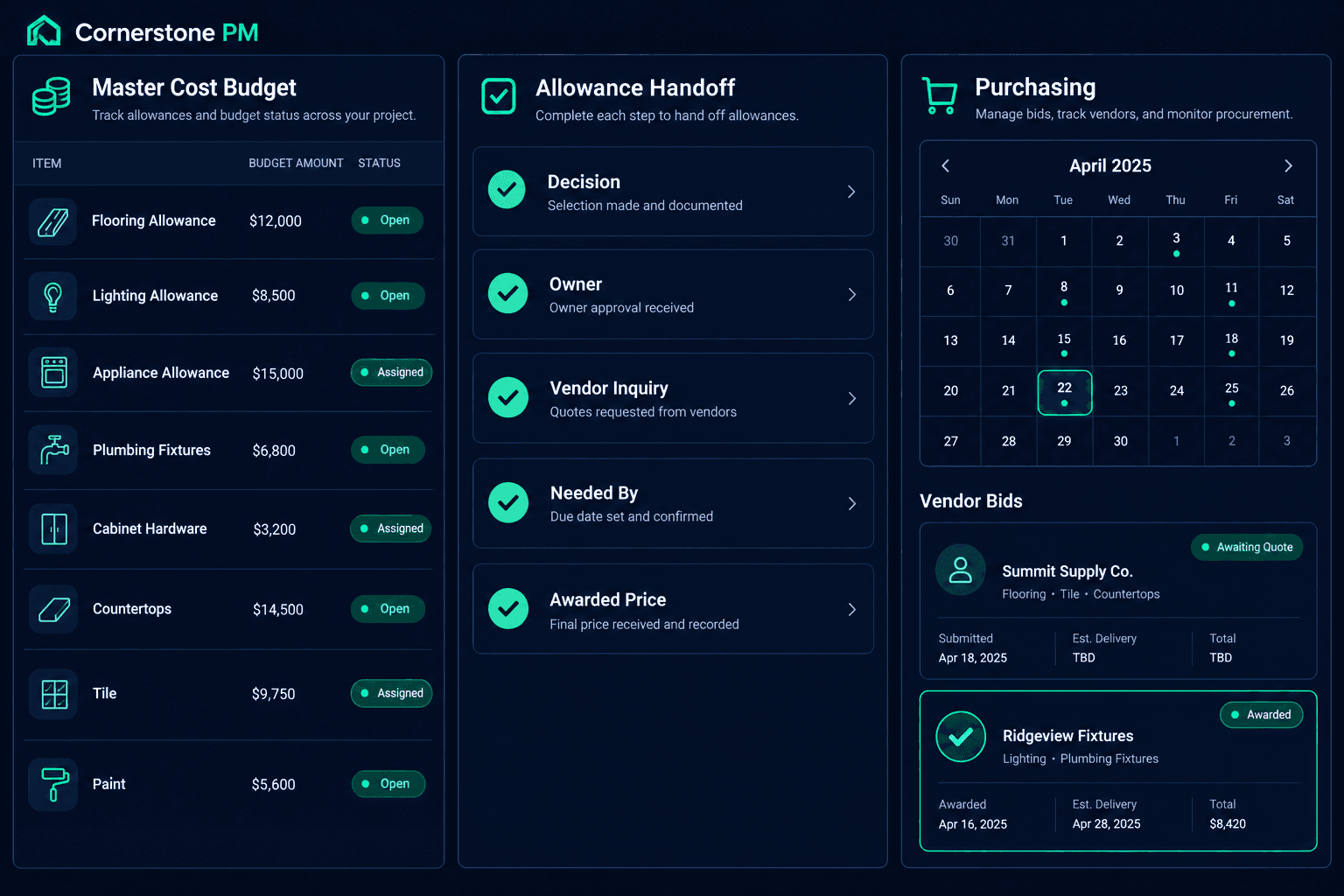
An unresolved allowance needs a named owner, a clear description of the open decision, and a needed-by date before it reaches purchasing. A dollar amount alone says how much you set aside, not who is going to close the decision or when.
Allowances are useful placeholders. They let a budget move forward while a selection, a finish, or a quantity is still open. The trouble starts when the placeholder sits untouched until someone needs a real price and discovers that nobody knows what was undecided or who was supposed to decide it.
This post describes a recommended operating practice for your team. Cornerstone supports allowances in the Master Cost Budget and scope-first area costs, but it does not add built-in allowance owner fields, reminders, or automatic escalation. The handoff below lives in whatever team tools you already use.
What should an allowance handoff record?
Keep it short. Five items are enough to turn a placeholder into a task someone can act on.
The handoff note
Open decision
What exactly is still undecided
Owner
One person responsible for closing it
Next vendor inquiry
Who gets asked for a quote, and with what details
Needed-by date
When purchasing needs the answer
Awarded price
The real number that replaces the placeholder
Why is a dollar amount not enough?
A line that reads “lighting allowance, $8,500” hides the real questions. Is the fixture style chosen? Is the buyer deciding, or the builder? Does the electrician need a count before quoting? Those answers are what purchasing eventually needs, and they are easiest to capture while the people involved still remember the conversation.
Who should own the decision?
Pick one person. A shared owner usually means no owner. The right person is whoever can actually make or collect the decision, often a project lead, a sales contact working with the buyer, or the superintendent. Write the name next to the open decision so the question has a home.
A placeholder is not an awarded price
Allowance amounts are budget placeholders. Parts and scope items in Cornerstone use accepted vendor pricing, so the handoff should end with a real quote replacing the placeholder, not with the placeholder quietly becoming the cost.
How do you set a useful needed-by date?
Work backward from the point where purchasing needs a real number. Allow time for the vendor inquiry, the quote, and a review. If a vendor needs a week to price and your purchase order goes out on the 20th, the decision is due well before the 13th. Write that date into the handoff, not just the date the item is eventually needed on site.
Where does the handoff live?
Use the tools your team already checks: a shared task list, a weekly meeting note, or a message thread. The important part is that purchasing and the superintendent can see it. For more on how allowances sit in the budget, read the allowances and the Master Cost Budget overview, and see how scope-first budgeting organizes costs by trade. Our vendor-priced budget rule explains why real quotes should replace estimates.
What happens once a price is accepted?
Close the loop. Update the handoff, note the awarded price, and let the budget reflect the real number. The allowance has done its job once a vendor price takes its place. If the decision slips past the needed-by date, flag it in your next team meeting rather than letting it drift into a late purchase order.
Give every open allowance an owner, an open decision, a next inquiry, and a date. That small note is what lets purchasing move quickly when the time comes.
Turn placeholders into priced decisions.
Keep allowances, vendor bids, and accepted pricing in one place. Start with the purchasing workflow.
Request Early Access