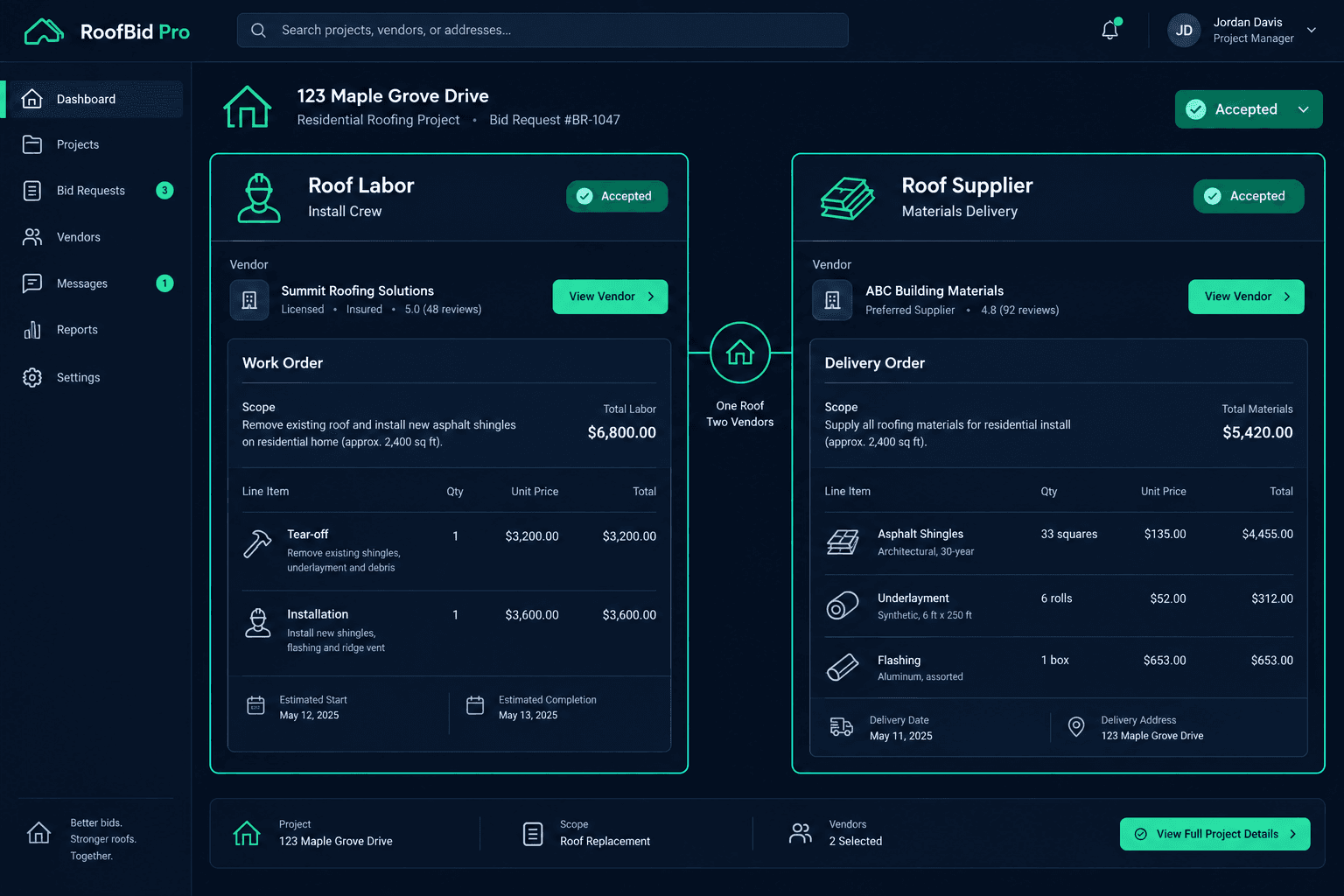
One Roof, Two Vendors: Separate Roofing Labor From Material Supply
A roof is one line item on a schedule but often two separate businesses: a labor crew that installs it and a supplier that provides the shingles, underlayment, and accessories. Bidding both scopes as a single request hides which portion is labor and which is material — and makes it harder to hold either vendor accountable for their piece. Cornerstone PM's purchasing module treats Roof Labor and Roof Supplier as distinct scope items so each can be bid, awarded, and tracked on its own.
Most trades on a home builder's schedule map cleanly to one vendor: one framer, one electrician, one plumber. Roofing is different often enough that treating it like every other single-vendor trade causes real problems. A production builder running the same roof plan across multiple communities may use a regional supplier for material and a local install crew for labor — and those two companies rarely quote as a package.
Why does bundling roof labor and supply into one bid cause problems?
When a single bid request covers both installation and material, a few predictable issues show up. First, vendors who only do one side of the job either decline to bid at all or pad their number to cover unfamiliar territory. A labor-only crew asked to quote material pricing will typically mark it up as a hedge, or skip line items they don't normally source. Second, comparing bids across vendors gets harder — one company's combined number and another's labor-only number aren't apples to apples on a side-by-side comparison. Third, when something goes wrong on site — a material shortage, a labor scheduling slip — a bundled bid makes it slower to identify which vendor is actually responsible.
How does Cornerstone PM separate roof labor from roof supply?
Cornerstone PM's scope-item structure includes Roof Labor and Roof Supplier as individually addressable scopes rather than a single bundled "Roofing" line. That means a purchasing coordinator can send a scope-filtered bid request to an install crew for labor only, and a separate scope-filtered request to a material supplier, without either vendor seeing or pricing the other's portion. Each bid moves through the same no-login vendor portal and status tracking as any other trade — Invited, Viewed, Submitted, Declined — and each can be awarded independently.
Roof Labor
Tear-off, disposal, and installation. Priced and awarded to an install crew, with its own accepted vendor cost and its own community-level assignment.
Roof Supplier
Shingles, underlayment, ridge vent, flashing, and other accessories. Priced and awarded to a material supplier, separately from the labor scope.
Does splitting the scope create duplicate costs in the budget?
Not if the two bid requests are scoped clearly. The risk of duplication comes from ambiguity, not from the split itself: if both requests are written broadly enough to plausibly cover the same work, a purchasing coordinator could end up with two accepted bids that overlap. The fix is a precise scope description on each request — Roof Labor covers installation and disposal, Roof Supplier covers material and accessories — so there's no gray area between them. Under Cornerstone's hard cost rule, each awarded bid contributes its own vendor-priced line to the budget, so a clean scope split shows up as two distinct, traceable costs rather than one padded estimate.
Freight and accessories are where gaps hide
Some suppliers quote delivered pricing; others quote pickup only. Some labor crews assume the supplier is covering flashing and drip edge; some suppliers assume the crew is sourcing their own accessories. Confirm both before award — Cornerstone doesn't automatically detect a mismatch between the two quotes.
What should a purchasing coordinator check before awarding either bid?
A short review checklist before awarding a split roof scope: confirm whether the supplier's quote is delivered or pickup, and who arranges freight if it's the latter; confirm whether accessories (ridge vent, drip edge, flashing, starter strip) are in the supplier's number or expected from the labor crew; and confirm the labor bid's tear-off and disposal scope matches what the schedule assumes. None of this requires new tooling — it's a matter of reading both scope descriptions side by side before either bid is accepted, the same way a coordinator would review any two related bids that touch the same physical work.
Once both are awarded, each vendor can carry a different community-level assignment, so a builder running several communities isn't forced to use the same labor-and-supply pairing everywhere. A regional supplier might serve every community while a different local crew installs in each one — and Cornerstone's per-community award model handles that without extra configuration.
Two scopes, two accepted prices, one clean budget
Roof Labor and Roof Supplier each carry their own accepted vendor cost once awarded. Both trace back to a real vendor bid — not a single blended "roofing" estimate that hides which side of the job actually costs what.
For the full purchasing workflow — bid request through purchase order — see Cornerstone PM's purchasing module.
Stop bidding labor and material as one blended number.
Cornerstone PM's scope-filtered bid requests let you award Roof Labor and Roof Supplier separately, by community, with accepted pricing that locks once awarded.
Request Early Access